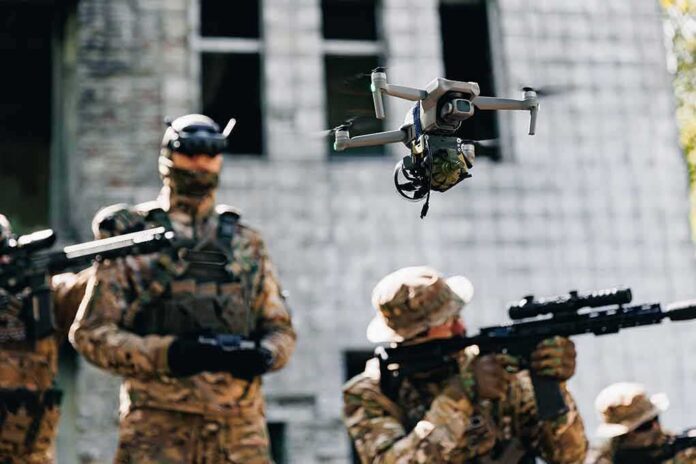
Marines flew explosive Neros Archer strike drones in a live-fire ambush drill at Japan’s Camp Fuji, marking the system’s first use on that range.
Story Highlights
- 31st Marine Expeditionary Unit conducted two live Neros Archer strike flights at Camp Fuji on October 20, 2026.
- Exercise used real explosives against set targets in an anti-armor ambush scenario, not a simulation.
- Event tied the drone to combined-arms training under the Fuji Viper series.
- Marine units previously ran live Archer strikes in South Korea and at Camp Lejeune.
Live Explosive Drone Strikes Executed at Camp Fuji
Marines from Battalion Landing Team 1/1 with the 31st Marine Expeditionary Unit flew two Neros Archer strike quadcopters during a live-fire event at Combined Arms Training Center Camp Fuji on October 20, 2026. Chief Warrant Officer 2 Stephen Bilbo said it was the first time Archers were used at Camp Fuji. The training used real explosive payloads and one-way attack profiles against marked targets, confirming the unit can launch and guide the system on that range.
Reporting described targets set on berms and an anti-armor ambush scenario. Marines flew the Archers in a “live kinetic variant,” meaning the platforms carried and delivered explosives instead of using inert or simulated loads. The event focused on strike accuracy and timing inside a small-unit fight. Range personnel and unit leaders coordinated to control the airspace, sequence the approach, and confirm impacts as part of the exercise timeline and safety plan.
Placed Within Combined-Arms Training Rather Than a Demo
Camp Fuji hosts the Fuji Viper series, which links infantry maneuver with fires. Marines folded the Archer into that framework to practice tracking a target, cueing a strike, and finishing an ambush with layered effects. The approach fits how the Marine Corps is testing drones: use controlled ranges to find what works, then scale tactics, techniques, and procedures across units. That method helps small teams add affordable precision to their fights.
Conservative readers should see this as practical strength: real tools, tested with a mission in mind, not a show. The Archer adds a precision punch for Marines on tight timelines and rough terrain. It hits armor or key points without risking a pilot. That is the kind of cost-effective edge that protects troops, conserves ammo, and deters bad actors. It is also a reminder that American warfighters adapt fast when leaders cut red tape and let training drive results.
Track Record: Korea and Camp Lejeune Live-Fire Milestones
The Marine Corps has flown live Archer strikes before. In South Korea, Marines conducted the first series of live first-person-view attack-drone flights and reported multiple successful hits at roughly 900 meters during summer 2026 training events. Local coverage said six drones launched and six hit during one drill, summarizing the early performance window under range conditions shaped for learning and safety.
Earlier, at Camp Lejeune in July 2025, Marines integrated the Archer with mortars and Javelin missiles during a combined-arms event. The Marine Corps characterized that as the first time a program-of-record system delivered a live lethal munition on a Corps-owned range. This placed the Archer inside a full kill chain, not as a gadget but as one more tool next to proven weapons that squads and platoons know well.
What This Means and What We Still Do Not Know
This Camp Fuji run shows steady progress. Marines flew real warheads, hit set targets, and linked the drone to an ambush plan. That matters for deterrence in the Indo-Pacific and for any future fight where small units must strike quick and move fast. The event confirms range readiness, operator skill, and basic reliability in a controlled setting. It does not claim broader results like performance under jamming or against air defenses, which were not reported.
🔴 U.S. Marines test Neros Archer FPV strike drone at Camp Fuji
Battalion Landing Team 1/1, 31st Marine Expeditionary Unit conducted two live-fire strike missions with the Neros Archer on Oct. 20 at Combined Arms Training Center, Camp Fuji, marking the first operational use of… pic.twitter.com/OBDhK7GyxY
— NewsTongue (@NewsTongueX) October 29, 2026
Bottom line for our community: this is a win for readiness and common sense. The Marine Corps is teaching young warriors to use low-cost precision tools that save American lives and taxpayer dollars. Under President Trump’s watch, the focus stays on real capability, not on empty buzzwords. Keep an eye on follow-on tests that add electronic-warfare stress and faster sortie rates. The more these drones integrate with infantry, the stronger and more flexible our force becomes.
Sources:
realcleardefense.com, mcsfr.marines.mil, stripes.com, defence-blog.com, koreatimes.co.kr, view.asiae.co.kr