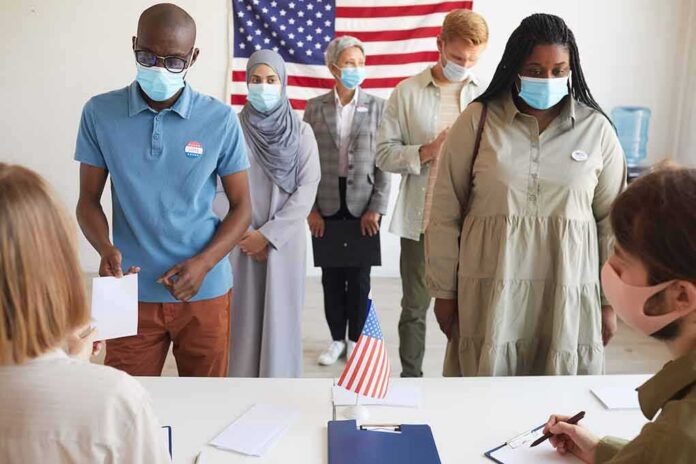
Minnesota’s own rules let people register on Election Day with a photo ID and a recent phone, TV, or internet bill—while already-registered voters are told they need no ID at all.
Story Snapshot
- Minnesota law allows same-day registration with a photo ID plus a recent utility-style bill.
- Active, current registrants are told they do not need to show ID at the polls.
- The state checks records after the fact, but offers no public count of noncitizen cases.
- Officials say only citizens can vote, yet polling-place rules rely on residence proofs, not citizenship papers.
What Minnesota Law Actually Allows at the Polls
Minnesota permits people to register at the polling place on Election Day. The person must fill out an application, take an oath, and show proof of residence. The state’s own guidance says a voter can pair a photo ID with a document that shows current name and address, such as a phone, television, or internet bill dated within the allowed window. That means a timely household bill can satisfy the residence piece. The key checks at the table are identity and address, not citizenship papers.
The same state site tells voters that if their registration is current and active, they do not need to bring identification to vote. That policy puts heavy trust in the accuracy of past files and mail checks. It also means poll workers often cannot confirm identity in real time for those already on the rolls. For many readers, that sounds like a system that prizes convenience over deterrence against fraud. The rule is on the books and reflected in state materials.
What Officials Say About Eligibility and Safeguards
Minnesota officials are clear on paper: only United States citizens may vote in Minnesota elections. They add that the state runs verification checks against Driver and Vehicle Services, the Social Security Administration, the Department of Health, and court records. If records flag temporary-visa noncitizens who appear as registered, those entries are challenged, the person must answer questions under oath before any ballot, and cases go to a county attorney. These steps are designed as backstops, not at-the-table citizenship proofs.
Officials also tout post-election audits and database matches to catch ineligible voters. They argue there is no evidence of large-scale noncitizen voting and have cited a review claiming only three noncitizen voting examples across 13.4 million ballots from 2015 to 2024. That is a tiny number if correct. But the public cannot see a statewide, detailed ledger of challenges, referrals, and outcomes. Without transparent counts, citizens cannot judge how many records were flagged, how many were cleared, and how many led to actual charges.
Why Same-Day Registration With Bills Raises Concerns
Same-day registration speeds access but reduces the time to verify. The state allows a utility-style bill to prove residence when paired with a photo ID. The bill must show the person’s name and address and be within the set date range. Critics worry this standard can be gamed. A bill is not hard proof of citizenship. At the polling place, there is no routine request for a citizenship document. That check lives in databases and later reviews, not in the moment.
Supporters of the current system point to the oath and penalties for lying. They say broad citizenship paperwork rules can block eligible voters. They prefer strong data checks and targeted enforcement after elections. Skeptics counter that after-the-fact detection is not prevention. Once a ballot is cast and separated from a name, it cannot be pulled back. They want real-time identity and eligibility checks that do not wait for database sweeps weeks later. That is a common-sense request in a high-trust system.
What Voters Should Watch For Next
Election integrity is not partisan. Every legal vote must count once, and only legal votes should count. President Trump’s administration backs strong safeguards. Still, state rules control local polling places. In Minnesota, the plain text shows convenience-heavy features: no ID for active registrants, same-day registration using household bills, and citizenship validated mostly through oaths and data checks later on. That design makes close, transparent reporting even more important.
🛑 Minnesota Election Official Goes on Somali TV: "You Don't Need to Bring Anything" (ID)🛑
Minnesota's voter outreach director, Melanie Hazelip, from Secretary of State Steve Simon's office, went on Somali TV of Minnesota and told viewers exactly how easy it is to vote in her… pic.twitter.com/4u9Zi5kFEs
— Katie K USA (@KimKatieUSA) October 27, 2026
Here are practical steps for clarity. First, Minnesota should publish aggregate counts each cycle: flagged noncitizen records, challenges at the polls, referrals to county attorneys, and case outcomes. Second, officials should release audit methods, match criteria, and error rates. Third, lawmakers should debate a uniform photo ID at the polls for all voters and a same-day eligibility check that confirms citizenship status in real time without blocking eligible citizens. Simple rules build trust while protecting every lawful ballot.