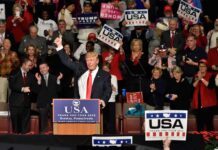

President Trump’s push for acting intelligence chief Bill Pulte to “start the process” of shrinking America’s spy bureaucracy marks the next step in a high-stakes effort to claw back a politicized, bloated intelligence establishment and return it to its core mission.
Story Snapshot
- Director of National Intelligence Tulsi Gabbard’s “ODNI 2.0” already ordered more than a 40% cut to the Office of the Director of National Intelligence (ODNI), projecting over $700 million in yearly taxpayer savings.[1]
- President Trump has now tapped housing regulator Bill Pulte as acting Director of National Intelligence and signaled he wants Pulte to keep shrinking the office.[1]
- Critics warn the cuts could weaken ODNI’s election-security and oversight functions, especially after specialized centers were slated for elimination or consolidation.[1][2]
- The battle over ODNI reflects a deeper fight over whether intelligence has been “weaponized” against political opponents or is being responsibly streamlined.[1]
Gabbard’s ODNI 2.0: Slashing Bloat and Refocusing the Mission
Director of National Intelligence Tulsi Gabbard’s “ODNI 2.0” blueprint fundamentally reshaped the intelligence coordinating office long before Bill Pulte entered the picture. Her plan committed to reducing the Office of the Director of National Intelligence by **over 40%** by the end of fiscal year 2025 and saving taxpayers more than **$700 million per year**.[1] Gabbard framed the overhaul as a “long-overdue transformation” aimed at ending bureaucratic “bloat” and reversing what she described as the “weaponization of intelligence,” while promising to preserve ODNI’s central coordinating role.
Under ODNI 2.0, the office was instructed to narrow its focus to “executing its core national security mission” as the “central hub for intelligence integration, strategic guidance, and oversight over the Intelligence Community.” Public reporting said the office had roughly **2,000** employees early in the process and was slated to be reduced to around **1,300** positions.[2] Several specialized units faced elimination, consolidation, or repurposing, including the Foreign Malign Influence Center and certain biosecurity and counterproliferation functions, underscoring the scale of change.[2]
Trump Turns to Bill Pulte to Keep Shrinking a Controversial Office
President Trump recently appointed Bill Pulte, the director of the Federal Housing Finance Agency and chairman of Fannie Mae and Freddie Mac, to serve as acting Director of National Intelligence following Gabbard’s decision to step aside.[1] Pulte will **retain** his housing roles while temporarily leading ODNI, a move the White House cast as leveraging his background managing complex, high-stakes institutions and large bureaucracies.[1][2] Acting officials can serve for 210 days after a vacancy opens, meaning Pulte’s acting tenure could extend into early 2027 absent a confirmed successor.[1]
News coverage and opposition voices have emphasized that Pulte has no apparent professional experience in intelligence or foreign policy, highlighting his career instead in finance, housing regulation, and market oversight.[1][2] Critics argue this background raises concerns about his ability to manage classified programs and complex global threats, while supporters point to his experience imposing discipline on powerful, entrenched institutions.[2] CBS reporting notes that ODNI had already undergone major restructuring under Gabbard, setting the stage for further streamlining under Pulte’s watch.[1]
Supporters See Reform; Critics Warn of Weakened Oversight
Supporters of the cuts argue that a leaner ODNI is not only possible but necessary, pointing to the agency’s own admission that it can shed more than 40% of its staff while still functioning as the central integration and oversight hub. ODNI’s public statements say the reorganization eliminates “redundant missions, functions and personnel,” consolidates overlapping structures, and focuses resources on core tasks, reinforcing claims that the office had grown beyond its original coordinating mandate. For fiscal conservatives frustrated with Washington excess, the advertised $700 million in annual savings is tangible evidence of long-awaited restraint.[1]
🆕 JUST NOW:
Trump has directed his acting Director of National Intelligence (DNI), Bill Pulte, to begin "mass firings" and significantly shrink the Office of the Director of National Intelligence (ODNI).
— Bella (@stockbella) June 5, 2026
Critics, however, warn that the same restructuring risks hollowing out important capabilities, particularly in areas like election-security and foreign interference monitoring.[2] Reporting notes that the Foreign Malign Influence Center and other specialized units have been reduced, folded into broader mission integration structures, or targeted for consolidation, prompting concerns that cross-agency cooperation against foreign meddling could suffer.[2] Opponents also argue that branding reforms as an effort to end “weaponization” invites suspicion that political considerations, not just efficiency, are shaping which programs are curtailed.
Conservatives Face a Strategic Question on Intelligence Power
The broader debate over ODNI reflects a long-running tension inside national security policy: how to balance effective coordination with the danger of centralized, unaccountable power. ODNI was created after the September 11 attacks to fix communication failures, but successive administrations have faced accusations that the intelligence establishment became politicized and used to advance partisan narratives.[1] Gabbard’s declassification efforts and reviews of past Russia-related assessments drew scrutiny, and some longstanding products like the “Global Trends” report appear to have been discontinued.[1]
For conservatives who believe intelligence agencies have been weaponized against them, the combination of ODNI 2.0 and Trump’s push for Pulte to continue shrinking the office represents a chance to rein in a bureaucracy seen as unaccountable and biased.[1] Yet the same conservatives also value strong national defense and clear-eyed intelligence about foreign threats, raising real questions about how far cuts can go without undermining coordination and oversight.[1][2] With hard outcome data on post-cut performance still lacking in the public record, the coming months under Pulte’s acting tenure will test whether a smaller ODNI can protect both liberty and security as promised.[1]
Sources:
[1] Web – Trump says he wants Pulte to “start the process” of shrinking intel …
[2] Web – US spy chief announces plans to shrink ODNI – Nextgov/FCW