
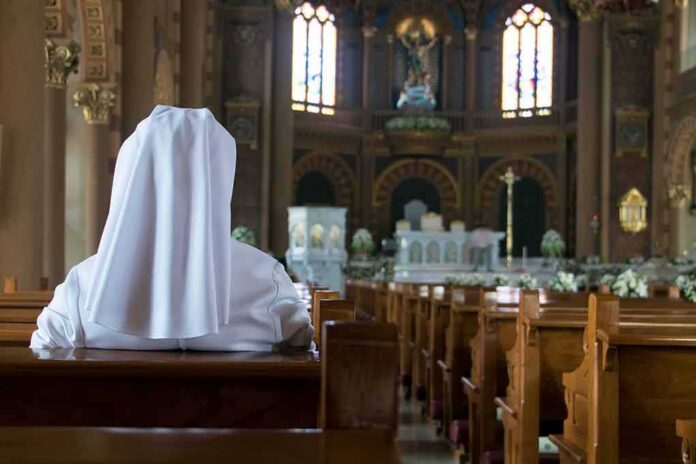
New York’s new assisted-dying law has turned Catholic nuns who care for the dying into plaintiffs fighting the state over whether government can force them to help patients end their lives.
Story Snapshot
- Catholic nuns and ministries have filed a federal lawsuit claiming New York’s Medical Aid in Dying Act compels them to assist suicides against their faith.
- The law’s supporters say it includes conscience protections and tight safeguards, but the nuns argue those do not cover required counseling, referrals, and facility duties.
- The case taps a growing, bipartisan fear that powerful officials and agencies override deeply held beliefs in the name of “progress.”
- How courts read this law will shape not only end-of-life care in New York, but the future of religious freedom in medicine nationwide.
Catholic nuns take New York to court over assisted dying
Four orders of Catholic nuns and several Catholic healthcare ministries have sued New York over its new Medical Aid in Dying Act. These groups include the Carmelite Sisters for the Aged and Infirm, the Dominican Sisters of Hawthorne, the Missionary Sisters of St. Benedict, and the Little Sisters of the Poor, along with the Diocese of Rockville Centre and Catholic Health, a network of Long Island hospitals. They filed their case in federal court, arguing that the law forces them to help end patients’ lives, which they see as a “culture of death” and a direct violation of Catholic teaching.
The nuns and ministries say their mission is to care for the sick, elderly, and dying until natural death, never to cause or speed that death. According to their lawsuit and public statements, New York’s law does not simply allow doctors to prescribe life-ending drugs for terminally ill adults; it also requires healthcare workers and facilities to inform, counsel, and qualify patients for those drugs or refer them to someone who will. They argue this turns every Catholic hospice, nursing home, and hospital into a front door for assisted suicide, even if no one on staff believes it is morally acceptable.
What New York’s Medical Aid in Dying Act actually does
New York’s Medical Aid in Dying Act allows certain terminally ill adults to request prescription medication that they can take to end their lives. Public summaries say the law only applies to state residents who are mentally capable, have a medically confirmed terminal illness with about six months or less to live, and make repeated, documented requests. The law requires two doctors to confirm the diagnosis and capacity, a waiting period between requests, an in-person evaluation, and a mental health check when capacity is in doubt. The patient must self-administer the drugs, which are prescribed and dispensed under strict rules.
Supporters of the law stress that it includes conscience protections for individual doctors and for religiously affiliated facilities. Legal explainers say that clinicians may decline to take part for moral or religious reasons, and that some facilities may bar assisted dying on their premises if they inform patients and arrange transfers when needed. From the state’s point of view, the law is not a blanket order forcing every provider to participate; it is a tightly regulated option for patients who want control over the timing of death and who meet detailed safeguards. But the exact legal language on what must be discussed, documented, or referred is complex, and that is where this lawsuit focuses.
Where religious freedom and end-of-life rules collide
The nuns’ complaint claims New York has gone beyond allowing assisted dying and is now punishing those who refuse to talk about it as a “benefit.” Becket, the religious liberty law firm representing them, argues that New York has made it unlawful to care for terminally ill patients without also offering suicide pills, no matter what the patients or providers want. The lawsuit says that Catholic doctors, nurses, and counselors must either deliver the state’s message about assisted dying, help qualify patients for the drugs, or refer them to someone willing to do so, under threat of fines or loss of license. They frame this as compelled speech and forced cooperation in acts they consider gravely wrong.
Born and bred in NYC, and all my life I have been waiting for a Muslim from Uganda to tell me what the city is.
Jews are not the only group the mayor has offended. He skipped the installation ceremony of Ronald Hicks as the new Catholic Archbishop of New York, replacing Cardinal…
— Karen David (@KarenDavid47792) July 15, 2026
This clash does not stand alone. Across the country, similar fights have erupted wherever medical aid in dying becomes legal. In California, Christian doctors won a ruling that the state could not force them to document patients’ requests for life-ending drugs and refer them to another doctor, because that violated their free speech and conscience rights. In Vermont and Canada, faith-based hospitals and doctors have fought rules that force them to discuss or provide euthanasia, arguing that even transfers and referrals make them part of the chain of death. These cases show a pattern: once a state opens the door to assisted dying, the next battle is over who must hold that door open.
Why this fight speaks to wider mistrust of the “deep state”
Many Americans, both conservative and liberal, already feel that powerful leaders treat ordinary people and their beliefs as obstacles, not partners. For some on the right, this case confirms fears that government will push a “culture of death,” using regulations to erase religious values in hospitals and nursing homes. For some on the left, it raises a different worry: if conscience protections are narrowed or ignored, the same government power that now targets nuns could one day target whistleblowers, civil-rights advocates, or anyone who refuses to echo the official line. In both views, the problem is the same—a distant state that tells people what they must say and do, even at the bedside of the dying.
The stakes also feel high because New York is already under federal fire for other rules that burden religious caregivers. The United States Department of Justice has sued the state over a separate law that forces Catholic nursing facilities to house men in women’s units based on gender identity, while allegedly treating non-religious facilities differently. That case paints a picture of a state government willing to override faith-based practices with one-size-fits-all social mandates. When you set that side by side with the assisted-dying dispute, it feeds a broader story of officials who say “comply or close” to institutions that have served the poor and sick for generations.
What to watch as the case moves forward
Key questions now lie in the hands of federal judges. They must decide whether New York’s conscience clauses truly shield religious facilities from having to counsel, refer, or host medical aid in dying, or whether those duties are baked into the law. They will also weigh whether forcing Catholic ministries to speak positively about assisted suicide violates the First Amendment’s protections for free speech and free exercise of religion. Early rulings on requests for injunctions will show how courts read the law’s fine print and how much weight they give to the nuns’ long record of caring for the dying poor.
Whatever the outcome, this fight goes far beyond one state and one statute. It asks a basic question many Americans now raise across issues from energy policy to immigration to healthcare: who decides where conscience ends and compliance begins? If courts side with the nuns, other states may need stronger religious protections in end-of-life laws. If courts side with New York, religious providers may face growing pressure to exit some forms of care rather than bend. For millions worried that elites in government write rules without listening, the answer in this case will be another measure of whether the system still respects deeply held beliefs when life and death are on the line.
Sources:
redstate.com, thegoodnewsroom.org, pjmedia.com, newsday.com, youtube.com, timesunion.com, justice.gov, foxnews.com, supremecourt.gov, pmc.ncbi.nlm.nih.gov, frblaw.com, governor.ny.gov, jdsupra.com, jurist.org, cityandstateny.com, jns.org, osvnews.com, compassionandchoices.org, becketfund.org