
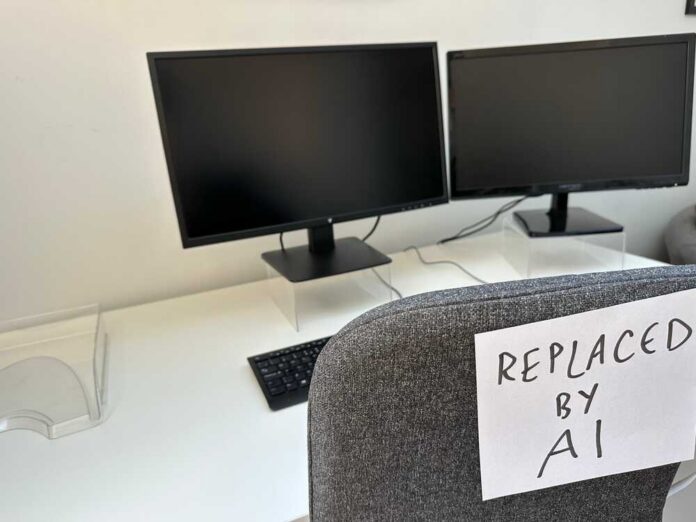
AI may soon make “abundance” possible—yet Americans could still end up ruled by a new, unelected tech aristocracy if government and markets don’t keep power in check.
Quick Take
- Multiple analysts argue AI is moving from “tools that help workers” toward automation that could replace large amounts of cognitive labor within a few years.
- Optimists foresee dramatically cheaper essentials—education, healthcare, and even energy—while skeptics warn real-world constraints like property and electricity won’t vanish.
- The biggest near-term risk is disruption: job insecurity, stagnant productivity, and widening inequality even as technology improves.
- Universal Basic Income (UBI) is increasingly discussed as a policy response, but it raises questions about dependency, inflation, and who controls the spigot.
- The central political fight is less about left vs. right and more about whether “elites” capture AI gains or citizens keep broad-based opportunity.
From “AI Assistance” to Automation Pressure on White-Collar Work
Jurgen Gravestein’s “Age of Abundance” thesis centers on a blunt projection: AI may automate cognitive labor far faster than most institutions are prepared for, possibly as soon as 2027. That timeline is inherently speculative, but the underlying trend is visible in rapid advances in model capability and “agentic” tool use. If automation replaces rather than augments workers, productivity gains could surge while household security weakens.
Today’s political tension comes from a familiar American pattern: powerful technologies create real wealth, then the distribution fight begins. Gravestein frames a choice between broad prosperity and an outcome where the owners of the “AI factories” become a durable ruling class. That concern resonates across ideological lines because it echoes longstanding distrust of entrenched elites—whether in Big Tech, finance, or permanent government bureaucracies.
Abundance Promises Run Into Real-World Limits
Supporters of an AI-driven boom argue that abundance isn’t just hype; it is the recurring story of technological progress. Past fears—like looming resource depletion or mass famine—often proved wrong as innovation expanded supply and boosted output. Andreessen Horowitz argues AI can enrich daily life by expanding creativity, productivity, and connection. Even so, optimism depends on competition and diffusion, not just breakthroughs inside a few firms.
Tom Blomfield’s commentary adds a practical caution that many voters immediately understand: some things remain scarce no matter how smart software gets. Land, housing in desirable areas, grid capacity, and physical infrastructure still constrain “near-free” living. That reality matters for policy because it suggests abundance may arrive unevenly—cheap digital services on one hand, and persistent affordability crises in housing and energy on the other, especially where regulation blocks expansion.
UBI and the New Dependency Debate
Many “abundance” forecasts pair automation with Universal Basic Income as a stabilizer for displaced workers. The idea is straightforward: if machines do more work, society can distribute part of the gains so families can meet basic needs. The political challenge is that UBI would shift leverage toward whoever controls eligibility, payment levels, and inflation management. Conservatives tend to worry that cash entitlements become permanent dependency and invite bureaucratic expansion.
At the same time, the research summary highlights current scarcity signals—rising inequality, food insecurity, and flat productivity in parts of the economy—despite major technological hype. That gap between promised progress and everyday struggle is exactly where public trust erodes. If AI wealth concentrates while living costs stay high, voters will likely see the system as rigged, feeding the bipartisan belief that government serves connected insiders first and citizens second.
What This Means in a GOP-Controlled Washington
With Republicans controlling the federal government in 2026, the policy question becomes whether Washington can encourage innovation while preventing cartel-like concentration. The conservative case is not to “stop AI,” but to defend competition, property rights, and transparent rules that keep start-ups and workers from being crushed by consolidated gatekeepers. That includes scrutinizing procurement, regulatory favoritism, and liability regimes that quietly pick winners.
The Age of Abundance Is Coming, But It Will Demand More from Us Than We Expecthttps://t.co/Ee1nToNNa4
— PJ Media (@PJMedia_com) April 18, 2026
Democrats will likely frame the debate around redistribution and “safety nets,” while many Republicans will prioritize deregulation and growth. The shared risk is letting a small, politically connected class write the rules while ordinary people absorb the disruption. The abundance story, if it proves real, won’t automatically restore the American Dream. It will require institutions that reward work, protect upward mobility, and prevent any new elite—public or private—from locking the public out.
Sources:
The Age of Abundance Is Coming, But It Will Demand More from Us Than We Expect
How AI Will Usher In an Era of Abundance
Possible futures: life in the age of abundance