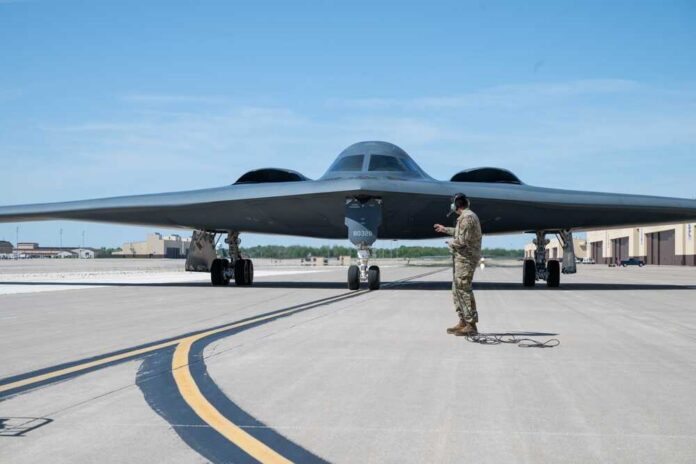
Chinese AI firms with direct ties to the People’s Liberation Army claim they successfully tracked America’s most advanced stealth bombers during combat operations over Iran, raising alarming questions about whether billions in taxpayer dollars invested in stealth technology have been rendered obsolete by commercial surveillance tools.
Story Snapshot
- Hangzhou-based firms Jingan Technology and MizarVision claim they tracked B-2 Spirit stealth bombers and carrier strike groups during Operation Epic Fury using AI-powered open-source intelligence
- Jingan released and later deleted purported audio recordings of B-2 radio communications, proclaiming “in the eyes of AI, there is no absolute stealth”
- Both companies serve as certified suppliers to China’s military, marketing their surveillance capabilities directly to the PLA and Central Military Commission
- The firms predicted US military action roughly 50 days in advance by detecting unusual force concentrations of over 100 warships and dozens of aircraft
- Planet Labs suspended Middle East satellite imagery sales at US government request following exposure of Chinese tracking capabilities
Chinese Surveillance Firms Target American Forces
Jingan Technology and MizarVision, two Hangzhou-based companies deeply embedded in China’s military-civil fusion strategy, publicly claimed they monitored US military movements throughout Operation Epic Fury’s opening phase in March 2026. Jingan posted audio allegedly capturing radio communications from four B-2 Spirit bombers during strike missions against hardened Iranian targets near Tehran, reconstructing flight paths primarily during their return phase. MizarVision simultaneously tracked carrier strike groups including USS Gerald R. Ford and USS Abraham Lincoln, plus aircraft stationed at bases in Saudi Arabia, Qatar, and Israel. The firms boasted they had monitored over 100,000 military movements using artificial intelligence platforms that fuse satellite imagery, flight tracking data, shipping information, and intercepted radio signals.
Direct Pipeline to Beijing’s War Machine
These aren’t independent tech startups—both companies function as direct suppliers to China’s People’s Liberation Army. MizarVision holds official National Military Standard certification as a PLA supplier, while Jingan markets itself as “China’s Palantir” and counts the PLA and Central Military Commission among its primary clients. Founded in 2021, these firms operate under China’s military-civil fusion doctrine, which deliberately blurs lines between commercial enterprise and state military capability. Their business model centers on selling “military-grade” intelligence derived from publicly available sources to Chinese defense agencies. The House Select Committee on China has warned that artificial intelligence now functions as a “battlefield surveillance tool” in Beijing’s hands, transforming commercial data into strategic military intelligence.
Tracking Methods Exploit Open Data Vulnerabilities
The Chinese firms claim they achieved surveillance success without traditional espionage, instead weaponizing freely available information. Their AI platforms fuse data from China’s Jilin satellite constellation with Western commercial satellite imagery, automatic identification system shipping broadcasts, and ADS-B flight tracking signals. Jingan asserted its systems detected unusual US force buildups in late January and early February 2026, predicting military action approximately 50 days before Operation Epic Fury launched. The firm’s analysis focused on carrier concentrations, aircraft deployments to Middle Eastern bases including Prince Sultan Air Base in Saudi Arabia, Al-Udeid in Qatar, and Ovda in Israel. This represents an evolution of open-source intelligence capabilities accelerated by the Ukraine conflict, but uniquely directed at real-time tracking of American military operations for Chinese state clients.
Unverified Claims Raise Propaganda Questions
Significant doubts surround the firms’ boldest assertions, particularly regarding B-2 bomber tracking. Jingan deleted its posted audio shortly after publication, and no independent verification confirms the recordings’ authenticity or successful interception of stealth aircraft communications. Defense analysts emphasize this reflects evolving signal intelligence and AI fusion methods rather than fundamental stealth technology failure. An anonymized Chinese defense source acknowledged constraints, noting the firms lack real-time access to US domestic data and rely heavily on public Western sources plus Jilin satellite feeds. The Washington Post investigation in mid-April 2026 exposed these companies’ activities, prompting Planet Labs to suspend regional imagery sales at US government request. Whether these claims represent genuine technical capability or nationalist propaganda designed to market services remains contested among Western defense experts.
Chinese Firm Claims It Tracked US Jets Over Iran During Operation Epic Fury https://t.co/Kab8NGGcfT
— zerohedge (@zerohedge) April 14, 2026
National Security Implications Demand Response
This development underscores a troubling reality: adversaries now exploit the open data ecosystem that underpins Western commerce and civil aviation to monitor American military operations. The firms’ previous tracking of B-52 operations near Venezuela in October 2025 and Pacific missile movements demonstrates sustained surveillance capability targeting US forces globally. Short-term implications include heightened Pentagon concerns over commercial open-source intelligence as an exploitable vector, already triggering restrictions on satellite imagery providers. Long-term consequences threaten to accelerate an AI-driven intelligence arms race where fusion of publicly available data challenges traditional military advantages. For taxpayers who funded decades of stealth technology development, these revelations raise fundamental questions about whether government and military leaders adequately protected operational security in an era where commercial satellites and artificial intelligence turn public information into weapons-grade surveillance.
Sources:
Chinese AI Firms Track US Military Movements During Iran War
Chinese Firms Market Iran War Intelligence, Exposing U.S. Forces
Chinese Companies Claim to Track US B-2 Stealth Bombers