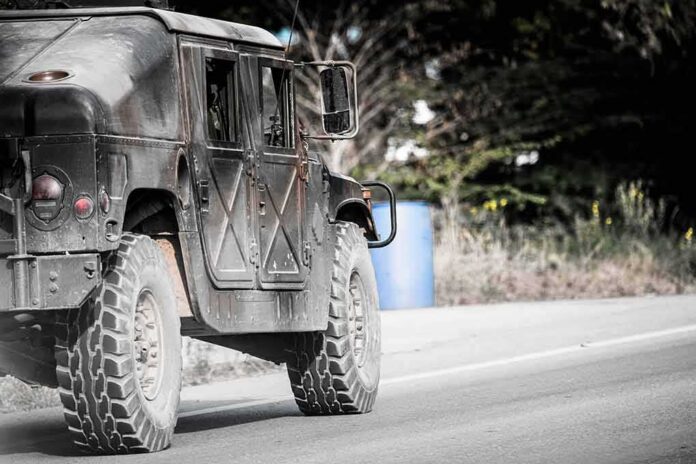
The Army just handed a defense contractor an 18-month deal to build robot trucks that can drive supplies to the front lines without putting a single soldier behind the wheel.
Story Snapshot
- American Rheinmetall won an 18-month U.S. Army contract under “Project Sustainment” to build hybrid-powered autonomous supply trucks.
- The vehicles are built on Harbinger’s platform, with help from partners Forterra and Primordial Labs.
- Five companies were chosen for Project Sustainment, including American Rheinmetall, AM General, Carnegie Robotics, HDT Robotics, and Stratom.
- The goal is simple: stop sending soldiers into danger just to haul supplies to the front lines.
Army Awards Contract to Automate Frontline Supply Runs
American Rheinmetall announced it received an 18-month contract from the U.S. Army to build autonomous, hybrid-powered uncrewed ground vehicles. The deal falls under Project Sustainment, an Army effort built to modernize how troops get supplies during combat. Instead of soldiers driving trucks into contested territory, robots will do the job.
The trucks are designed to roll straight to frontline units without a human driver risking ambush, roadside bombs, or enemy fire along the way. One industry partner involved in the project put it plainly on social media: the technology “will save lives of army soldiers who would previously have to drive”. That’s the entire point, and it’s hard to argue with saving American lives.
Five Companies Race to Build the Army’s Robotic Convoy
American Rheinmetall isn’t working alone. The Army picked five companies for Project Sustainment: American Rheinmetall, AM General, Carnegie Robotics, HDT Robotics under the brand BLADE, and Stratom. HDT Robotics has already unveiled its own entry, a machine called Dire WOLF, built to haul supplies without a human in the seat.
American Rheinmetall’s new trucks are built on a platform from its partner Harbinger, with autonomous driving software supplied by Forterra and Primordial Labs. The company is also competing separately in the Army’s Ground Optionally Autonomous Transport program, another effort aimed at building rugged, versatile robots that can move supplies and gear across difficult terrain. Competition among contractors should keep costs in check and push better technology to soldiers faster.
Decades of Testing Pave the Way for Combat-Ready Robots
This isn’t the Army’s first attempt at removing soldiers from harm’s way on supply runs. Back in 2023, the Army and the Defense Innovation Unit picked three companies — Neya Systems, Robotic Research Autonomous Industries, and Carnegie Robotics — to build heavy-duty vehicles that could navigate rough terrain and resupply troops on their own. The Army has also worked with British forces on last-mile autonomous resupply missions.
Yes. The US Army has used up much of its stockpile of highly accurate long-range missiles during its five-month war with Iran.
The missiles are principally the Army's surface-to-surface weapons, known as Army Tactical Missile Systems (ATACMS) and Precision Strike Missiles…
— MCDC25 (@25_mcdc) August 5, 2026
Oshkosh Defense has been building toward this goal for years too. The company landed a $49 million contract back in 2018 for 70 autonomy kits fitted onto existing supply trucks. More recently, Oshkosh delivered 16-ton self-driving cargo trucks under an $89 million order meant to carry heavy gear without risking a driver’s life. The Army has openly said this kind of semi-autonomous resupply is meant to cut down risk to troops on the battlefield.
American Rheinmetall has a track record with the Army beyond robotics too, having partnered with GM Defense back in 2023 on the first phase of the Army’s Common Tactical Truck Program. That history of delivering hardware on time matters when taxpayers are footing the bill for new technology meant to protect troops rather than just modernize for modernization’s sake.
Every one of these contracts points to the same conservative principle worth cheering: use American engineering to keep our men and women in uniform out of the line of fire whenever possible. A robot truck that takes a hit from an improvised bomb costs money to replace. A soldier who takes that same hit costs a family everything. This is exactly the kind of defense investment that puts troops first instead of chasing headlines or political fads, and it deserves continued support as the Army pushes these vehicles from testing toward real combat use.
Sources:
military.com, rheinmetall.com, facebook.com, linkedin.com, defence.gov.au, militaryaerospace.com, army.mil, defensenews.com, instagram.com