The argument that Anthony Fauci “partially waived” his Fifth Amendment rights by giving an opening statement is legally plausible in theory but, on the record we have, remains an unresolved and highly contestable claim rather than an established fact.
Key Points
- Fauci made a brief opening statement at a Senate hearing, then invoked the Fifth Amendment and refused to answer substantive questions more than 100 times.
- His remarks acknowledged the hearing’s subject matter and criticized its motives, but also expressly announced his intention to invoke the Fifth and “refrain” from answering questions.
- Some senators and commentators argue that by speaking at all on the same topics later raised in questioning, Fauci partially waived his privilege; others see his invocation as categorical and intact.
- Fifth Amendment “testimonial waiver” doctrine is fact‑specific and murky in congressional settings, and no court or committee ruling has yet held that Fauci’s opening statement created a waiver.
What Happened at the Hearing: The Sequence That Drives the Waiver Debate
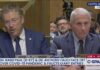
To understand the waiver argument, you have to start with the choreography of the hearing itself. Fauci appeared under subpoena before the Senate Homeland Security Committee, chaired by Senator Rand Paul, for a high‑profile examination of the origins of Covid‑19 and the federal response to the pandemic. After being sworn, he delivered a concise opening statement: he defended his record, criticized what he described as Paul’s “clear fixation on pursuing my prosecution,” and then announced, in explicit terms, that on the advice of counsel he would invoke his rights under the Fifth Amendment and refrain from answering the committee’s questions.
Once that statement concluded, Fauci followed through. For roughly three hours he declined to answer virtually every question, repeating some variation of “On the advice of counsel, I respectfully decline to answer based upon my rights under the Fifth Amendment of the Constitution.” Coverage and committee accounts agree that he did not engage substantively even on seemingly innocuous matters—at one point, according to one summary, he invoked the Fifth when asked about the color of his tie. By the end of the hearing, reporters and members were remarking on the sheer volume of invocations: about 100 to 111 times, depending on the count.
That sequence—the mix of an opening statement touching the hearing’s themes, followed by blanket refusal—is the factual backbone of the current waiver dispute.
Fifth Amendment Basics: What Counts as “Waiving” the Privilege?
The Fifth Amendment’s core protection is familiar: no person “shall be compelled in any criminal case to be a witness against himself.” In practice, the privilege applies beyond criminal trials; it can be invoked in civil cases and in congressional hearings when truthful answers could reasonably expose the witness to criminal liability. Waiver comes into play when a witness voluntarily testifies about incriminating subject matter and then tries to shut down further questions on the same topics.
Courts have long distinguished between two ideas. First, a witness may choose to speak on some subjects and assert the privilege on others; that is not, by itself, improper. Second, however, once a witness gives substantive, self‑incriminating testimony about a particular topic, he typically cannot use the privilege to block “related” questions that would simply flesh out or clarify what he has already chosen to disclose. That is often called “subject‑matter waiver.” The line is narrow and fact‑specific: judges ask whether the earlier statement was truly testimonial on the contested facts, whether it was voluntary, and how closely the later questions track the same evidentiary terrain.
Two additional wrinkles complicate the Fauci debate. One is the setting. Congressional hearings are not courts, and privilege disputes there rarely receive the kind of detailed, line‑by‑line analysis that a trial judge might conduct. Another is the overlay of a presidential pardon—here, a broad Biden pardon covering Fauci’s federal exposure for actions connected to his government roles from 2014 to 2025. That pardon arguably eliminates federal criminal risk for many topics, but it does not erase all possible liability (for example, state offenses), nor does it immunize him from perjury if he chooses to answer and lie.
The Case for a Partial Waiver: Why Some Argue Fauci Opened the Door
Those who claim Fauci “partially waived” his Fifth Amendment rights focus on the content and timing of his opening statement. In that statement, according to video and transcript, he did more than say “good morning” and announce a legal posture. He defended his pandemic response, rebutted accusations that he had misled the public, and framed the hearing as politically motivated—specifically, as an effort by Senator Paul to generate statements that could be used to lock him “behind bars.”
Because the subsequent questioning revolved around those same broad themes—origins of Covid‑19, funding of research at the Wuhan Institute of Virology, gain‑of‑function research, public communications about risk, and his conduct as a federal official—critics argue that any factual assertions in the opening statement about his conduct, decisions, or motives should be treated as voluntary testimony. In their view, once Fauci chose to “tell his story” on those points, he could not legitimately refuse follow‑up questions that probed the details of the story, at least on the same topics.
Some members went further, tying the waiver argument to the pardon. Senator Josh Hawley cited Supreme Court precedent, including Brown v. Walker (1896), for the proposition that a fully pardoned witness “may not stand upon his privilege,” and used that to assert that Fauci had “no rights under the Fifth Amendment” in this setting. Combined with Fauci’s defensive opening about his Covid record, Hawley and others presented his refusal to answer as both legally unjustified and effectively self‑incriminating.
This is the logic behind the “partial waiver” claim: voluntary, subject‑matter‑overlapping opening remarks, plus a broad federal pardon, plus blanket refusal, equals a privilege that has been at least partly waived on the topics addressed.
The Counter‑Case: Why Many See Fauci’s Invocation as Intact
There is, however, a substantial body of commentary and reporting that treats Fauci’s Fifth Amendment assertion as categorical and intact rather than partially waived. Major outlets such as NBC, CNN, Science, and C‑SPAN describe his opening statement primarily as a procedural and contextual remark: he explained why he felt targeted, voiced respect for Congress, and then clearly announced that he would invoke the Fifth Amendment to avoid being drawn into a perjury trap.
From this perspective, the crucial point is not that he spoke, but how narrowly he spoke. If the opening statement is characterized as general framing—explaining his reasons for asserting the privilege and giving a non‑specific defense of his public record—rather than granular factual testimony about specific decisions, then it looks less like subject‑matter waiver and more like an introduction to a blanket invocation. The subsequent behavior reinforces that view: Fauci did not alternate between answering and refusing; he refused consistently and repetitively, even when questions drifted toward less directly incriminating terrain.
Legal analysts viewing the footage have emphasized the doctrinal uncertainty. George Washington University law professor Jonathan Turley, speaking on Fox News, described the waiver question here as “a murky area” and noted that courts tend to give witnesses some leeway when they make limited introductory remarks but then assert the privilege. Jessica Levinson, a CBS News legal contributor, focused instead on the pardon angle and concluded that, practically speaking, Fauci is unlikely to face contempt liability given the breadth of the federal pardon and the residual risk of state‑level or future charges.
Crucially, no court has yet issued a ruling that Fauci’s opening statement waived his Fifth Amendment rights, whether partially or fully. Nor has a Senate contempt proceeding so far produced a detailed privilege opinion dissecting his remarks sentence by sentence. The claim of waiver, at this stage, is a litigation position and a political talking point, not a judicially endorsed conclusion.
How Waiver Would Be Analyzed If It Ever Reached Court
If this dispute does reach a federal judge—for example, through a contempt referral seeking an order to compel answers—the analysis will turn on a granular transcript comparison rather than generalized impressions. A court would likely examine Fauci’s opening statement line by line and categorize each sentence: is it merely argumentative or rhetorical, or does it assert concrete facts about his decisions, knowledge, or actions that tie directly to potential criminal theories?
Next, the judge would compare those specific assertions to the questions he refused to answer. If, in the opening, Fauci voluntarily stated detailed facts about, say, the approval of particular grants to the Wuhan Institute of Virology, his knowledge of gain‑of‑function work, or his interactions with staff regarding lab‑leak concerns, then refusing follow‑up questions on those same episodes could look like subject‑matter waiver. If, instead, his remarks stayed general—“I acted in good faith based on the science,” “these attacks are politically motivated”—courts are more likely to treat them as non‑waiving explanations that do not open the door to compelled testimony.
Any ruling would also have to reckon with the pardon. A judge could conclude that for federally pardoned conduct, the Fifth Amendment privilege no longer applies because there is no realistic federal prosecution risk; that is the Brown v. Walker logic Hawley invoked. But even then, the court would have to consider unresolved exposure: state prosecutors, future acts outside the pardon’s temporal scope, or perjury if Fauci answered and departed from the truth. Those residual risks can sustain a privilege claim, at least in part.
In short, a serious waiver analysis is technical and narrow; it requires tools—complete transcripts, privilege briefs, and formal findings—that the public debate has not yet produced.
Politics, Optics, and the Persistent Misreading of the Fifth Amendment
Fauci’s hearing sits inside a broader pattern in modern congressional oversight. When a polarizing figure invokes the Fifth Amendment, each side immediately reads that legal move as a moral or political signal. Committees frame a witness’s silence as proof of wrongdoing or arrogance; witnesses and their counsel treat aggressive questioning as evidence of persecution, not oversight. The privilege itself—designed as a shield against compelled self‑incrimination—turns into a canvas for narrative warfare.
In this case, Republicans have emphasized the raw optics of “111 Fifth Amendment pleas” and the contrast with Fauci’s previous cooperative testimony over decades. Democrats and some legal experts respond that the sheer scale of political animosity, combined with an environment where inconsistent statements could trigger perjury accusations, makes full invocation a rational, if deeply unpopular, protective strategy. The waiver argument becomes one more front in that battle: a way for one side to characterize limited speech as a trapdoor, and the other to insist that a line was held.
For citizens trying to make sense of it, two points are worth holding simultaneously. Invoking the Fifth Amendment does not prove guilt, and it does not erase legitimate public demands for transparency after a mass‑casualty event. And until a court or formal congressional opinion analyzes Fauci’s opening statement against established doctrine, the claim that he “partially waived” his rights will remain exactly what it is today: a contested theory, not a settled legal fact.
On July 29, 2026, the American people watched Dr. Anthony Fauci sit before the Senate Homeland Security and Governmental Affairs Committee, chaired by Sen. Rand Paul, and refuse to answer more than 100 questions. He invoked the Fifth Amendment repeatedly, claiming Sen. Paul’s…
— Common Sense with Chad Law (@chadparkerlaw) August 3, 2026
Where This Leaves the Waiver Question Today
So did Fauci partially waive his Fifth Amendment rights? The honest answer is that we do not yet have a definitive legal ruling, and the record is not one‑sided enough to declare waiver as a matter of clear doctrine. He did give a brief, substantive‑flavored opening statement, and some of that content appears to overlap with the hearing’s main themes. That overlap is what fuels the waiver argument. At the same time, he announced his invocation inside that very statement, then adhered to a blanket refusal strategy that is consistent with a deliberate, counsel‑driven effort to avoid any incremental exposure.
Until someone places the full transcript before a judge and litigates the question, the best one can say is this: partial waiver is a real issue in Fifth Amendment law, and Fauci’s hearing presents facts that make it a non‑frivolous question. But the evidence as it stands does not justify treating that waiver as already established. The debate is less about what the Fifth Amendment clearly requires, and more about how law, politics, and public anger collide when a central figure in a national crisis chooses, finally, not to answer.
Sources:
townhall.com, nbcnews.com, aljazeera.com, youtube.com, mace.house.gov, pbs.org, npr.org, wsj.com, facebook.com, usatoday.com