
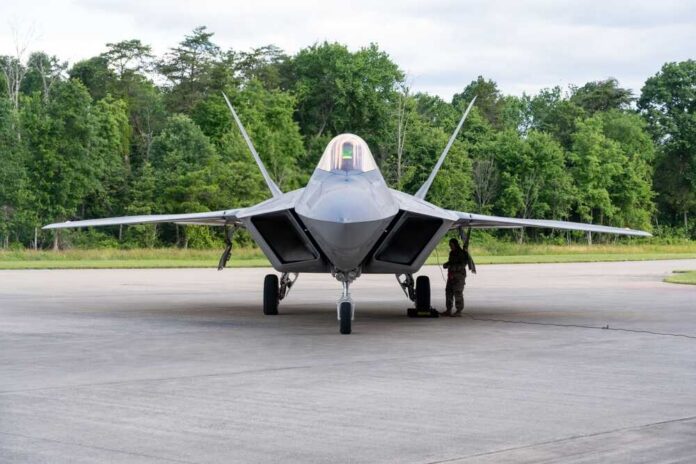
America’s F-22 Raptor engine just logged one million flight hours, a hard proof of U.S. air superiority that rivals have chased for decades.
Story Highlights
- Pratt & Whitney’s F119 engine surpassed one million flight hours powering the F-22 Raptor.
- The F119 is described as the world’s first fifth-generation fighter engine with supercruise and thrust vectoring.
- Each U.S. Air Force F-22 uses two F119 engines; the fleet has flown with them for over 20 years.
- Claims of “unmatched” reliability lack third-party comparative data against Chinese or Russian engines.
F119 Hits One Million Hours, Underscoring U.S. Air Dominance
Pratt & Whitney announced the F119 engine powering the Lockheed Martin F-22 Raptor has passed one million flight hours. The company called the engine the pioneering fifth-generation fighter engine and credited it with supercruise, thrust vectoring, and advanced stealth support for the Raptor. The milestone reflects decades of operations by U.S. Air Force squadrons that rely on the twin-engine F-22 to secure the skies. For a nation that values peace through strength, this is a concrete win.
The manufacturer said the F119 has delivered capability, safety, and strong readiness over more than 20 years of service on the F-22. Two F119s power every operational Raptor, giving the jet extreme thrust and control at high angles of attack. Supercruise lets the F-22 fly faster than the speed of sound without afterburner, saving fuel and reducing heat and signature. Those are real combat advantages, not buzzwords, when deterrence and quick response times matter.
What Makes a Fifth-Generation Engine Different
Pratt & Whitney cites several traits that set the F119 apart: high thrust, precise thrust vectoring, efficient supercruise, and integration with a stealth airframe. Thrust vectoring nozzles help the pilot point the jet’s nose faster, which can decide a dogfight in seconds. Supercruise keeps the jet fast without the telltale glare and fuel burn of afterburners. When paired with the F-22’s design, the engine helps shrink the jet’s radar and heat signature, aiding survivability and mission success.
These features took years to perfect and keep ready. Engine hours are a hard metric that shows real-world use. A million flight hours mean countless sorties, training missions, alerts, and deployments completed with engines that performed under stress. That kind of track record builds trust with pilots and maintainers who bet their lives on every takeoff. It also sends a signal to adversaries that America can surge power when needed.
How This Stacks Up Against China and Russia
RTX and Pratt & Whitney describe the result as “unmatched,” but they do not offer verified comparative data for Chinese or Russian fifth-generation engines in the release. Analysts note that this is a common pattern in defense marketing and reporting, where firms highlight achievements without third-party comparisons. The milestone stands on its own, but a direct, audited match-up with China’s WS-15 or Russia’s AL‑41F1 has not been published by the U.S. Air Force or the Department of Defense.
China’s state and commercial outlets have promoted progress on the WS-15 engine for the J-20, including claims about supercruise and higher peak thrust. Those reports vary and often lack verified fleetwide hours and reliability rates. Open-source writeups list performance targets, but they do not match the U.S. engine’s documented operational hours across a mature fleet. Without common, audited metrics, any one-to-one ranking stays incomplete for now.
Why This Matters for Readiness, Budgets, and Deterrence
One million hours mean more than a round number. It ties to training pipelines, maintenance cycles, and spare parts planning that keep squadrons mission-ready. Reliable engines cut downtime and help commanders surge sorties when crises hit. That readiness is a core mission of the federal government, and it should be measured in hours flown, not talking points. The F119’s record supports that mission today while the nation invests in next-generation propulsion for tomorrow.
🇺🇸 Pratt & Whitney F119 engines powering the U.S. Air Force's F-22 Raptor stealth fighter aircraft has surpassed one million engine flight hours. @RTX_News
Two F119 turbofan engines power each F-22 Raptor fifth-generation fighter aircraft, delivering unparalleled aircraft… pic.twitter.com/njbr0Xioin
— DefPost (@defpostmedia) June 30, 2026
Looking ahead, adaptive cycle engines promise bigger range, cooler operation, and bursts of extra thrust for future fighters. Public summaries say these designs could cut fuel use while adding performance, improving both combat power and cost control over time. For taxpayers, that means a stronger punch per dollar. For aircrews, it means safer margins and more options in a fight. The F119’s milestone shows what steady, American-made engineering can deliver while the next wave comes online.
Bottom Line and What We Still Need to See
The F119 crossing one million flight hours is a U.S. win, plain and simple, achieved on an operational stealth fleet under real demands. The engine helped make the F-22 a fearsome guardian of American airspace. At the same time, claims of “unmatched” performance would be stronger with independent, apples-to-apples data on foreign engine flight hours, failure rates, and availability. Until then, this milestone stands as fact, and America’s lead in combat-proven propulsion remains clear.
Sources:
19fortyfive.com, investing.com, prnewswire.com, defenseopinion.com