
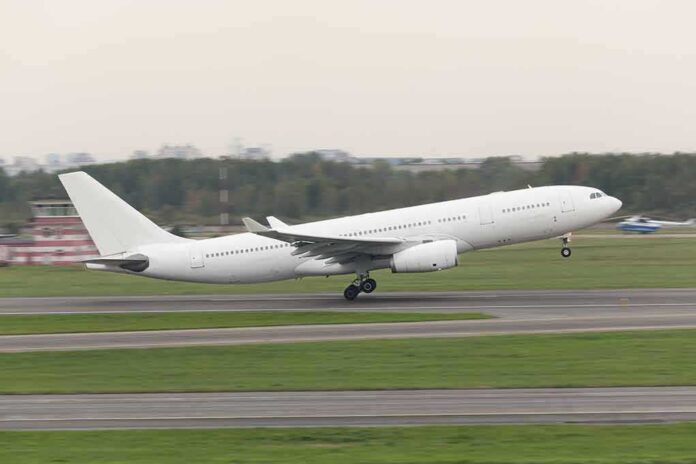
Newly released federal footage showing a UPS cargo jet’s engine ripping off seconds after takeoff is raising hard questions about whether regulators and Boeing let a known problem linger until 15 people were dead.
Story Snapshot
- NTSB hearings spotlight how a UPS MD‑11 cargo jet lost its left engine moments after liftoff in Louisville, killing 15 people.
- New surveillance and animation footage shows the engine and pylon separating from the wing before the aircraft slammed into buildings.
- Investigators are probing fatigue cracks in engine‑mount hardware and whether earlier warning signs were ignored.
- Boeing, UPS, and the Federal Aviation Administration face scrutiny as conservatives demand transparency, accountability, and safer skies.
New Footage Shows Engine Tear Away Before Fatal Impact
Newly released airport surveillance video from Louisville’s Muhammad Ali International Airport shows the left engine and the structure holding it to the wing tearing away from UPS Flight 2976 just as the cargo jet lifted off runway 17 Right on November 4, 2025.[1][3] The Boeing McDonnell‑Douglas MD‑11F briefly climbed to about 30 feet before losing control, clipping buildings, and exploding in a fireball that killed all three crew members and 12 people on the ground.[1][3]
Video and National Transportation Safety Board (NTSB) animations entered into the public docket reveal the engine and pylon separating and falling near the runway while the crippled jet staggered ahead.[1][3] Investigators say the engine detachment triggered a catastrophic loss of control, giving the pilots virtually no chance to save the aircraft or the people in its path.[1] The dramatic visuals have shocked Americans and intensified calls for answers about how such a basic structural failure could occur in modern aviation.[3]
NTSB Hearing Probes Fatigue Cracks and Prior Warning Signs
The NTSB has opened a two‑day investigative hearing in Washington, District of Columbia, focused on why the engine “fell off” and whether an underlying flaw or missed inspections played a role.[1][2] The hearing, tied to accident docket DCA26MA024, brings together parties from the Federal Aviation Administration (FAA), UPS, The Boeing Company, General Electric Aerospace, and pilot unions to question the design, maintenance, and oversight of the MD‑11’s engine‑to‑wing attachment.[1][2]
Preliminary investigative materials describe fatigue cracking in the engine‑mount hardware, including bearing components in the pylon structure that transfers engine loads into the wing.[2] According to NTSB summaries, cracks in these parts can grow over time, alter how forces move through the mount, and eventually overload key attachment lugs until they fracture and the engine separates.[2] That kind of slow‑burn failure demands rigorous inspection regimes, clear guidance from manufacturers, and assertive oversight from federal regulators, all of which are now under the microscope.[1][2]
Systemic Oversight Questions for Boeing, UPS, and Regulators
Investigators have already documented at least ten prior reports in the fleet of fractured or migrated bearing races in similar pylon hardware, raising the stakes for Boeing and the FAA.[3] The hearing is examining whether those earlier events should have triggered stronger inspection mandates or redesign efforts before UPS 2976 ever left the gate that day.[1][3] Media coverage notes that previous McDonnell‑Douglas widebody models also experienced serious engine‑mount issues, adding more context to questions about long‑term design robustness.[3]
The NTSB has pointedly asked why Boeing did not address an apparent underlying vulnerability sooner and whether the FAA’s response, including past inspection directives, went far enough to protect the public.[3] At the same time, the Board has emphasized that it has not yet issued a final probable‑cause report, reminding the public that multiple factors—design, maintenance practices, operating procedures, and oversight—could intersect in this tragedy.[1][2] For families who lost loved ones, and for every American who steps onto an airplane, that distinction matters less than making sure such a failure never happens again.
What This Means for Safety, Accountability, and Limited Government
The Louisville disaster exposes a familiar Washington pattern: agencies like the FAA often rely heavily on manufacturers to police their own designs, while real accountability only comes after lives are lost.[1][3] Conservatives who believe in limited but effective government see a difference between bloated bureaucracy and focused safety enforcement. The lesson from UPS 2976 is not that we need more red tape on passengers, but that we need regulators to do their core job—demanding honest data, fixing known hazards, and refusing to rubber‑stamp corporate assurances.
Newly released NTSB footage shows the terrifying moment a UPS cargo plane lost an engine seconds after takeoff in Louisville, Kentucky.
The surveillance video captures the aircraft’s left engine and pylon separating from the wing shortly after the plane lifted off the runway.… pic.twitter.com/51rT1bup11
— The patriots ledger (@EmiLiack77) May 20, 2026
As the Trump administration’s transportation and safety officials navigate this investigation, they face a clear mandate from everyday Americans: end cozy complacency, insist on transparency from Boeing and UPS, and make sure inspection rules are grounded in real‑world evidence instead of corporate convenience.[1][2][3] The NTSB’s public docket and hearings offer a rare window into how the system really works. Citizens who value strong families, free enterprise, and the sanctity of life have every reason to watch closely and demand that aviation safety be about one thing only—protecting people, not protecting reputations.
Sources:
[1] Web – DCA26MA024.aspx – NTSB
[2] YouTube – NTSB to hold hearings soon in DC to gather more info on UPS plane …
[3] Web – NTSB shares video of engine falling off UPS plane amid deadly …