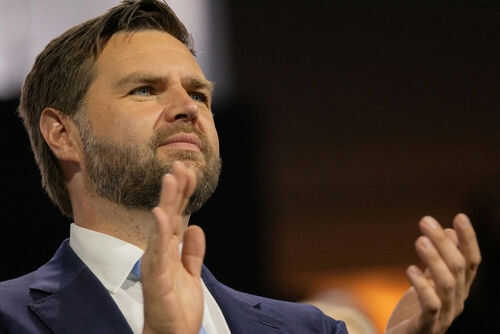
JD Vance’s sudden rise as the GOP’s 2028 frontrunner shows how the Trump-era “America First” coalition is already planning its next chapter—and it has the old establishment scrambling to keep up.
At a Glance
- Vice President JD Vance is emerging as the leading Republican prospect for 2028, backed by polling that shows strong early primary support.
- Vance holds uncommon institutional leverage as a sitting vice president while also serving as finance chair of the Republican National Committee.
- President Trump has praised Vance while avoiding a formal anointment, keeping maximum leverage over the party’s future direction.
- Other recognizable Republicans—Ron DeSantis, Donald Trump Jr., Marco Rubio, and Ted Cruz—trail Vance in early measures of consideration and “ideal candidate” support.
Polling and Party Signals Put Vance on Top Early
A YouGov/Economist survey conducted March 30 through April 1, 2025 found Vance with the widest early runway among Republicans considering a 2028 primary vote. The poll reported that 69% of Republicans would consider voting for Vance, and 44% named him as their ideal candidate. By comparison, Ron DeSantis drew 42% consideration with 9% as ideal, while Donald Trump Jr. posted 39% consideration and 12% ideal.
Those numbers don’t “settle” a contest that is still years away, but they do show where the grassroots mood is trending: continuity with the current administration instead of a return to pre-Trump messaging. For conservative voters who watched the Biden years normalize aggressive federal activism—on spending, culture-war bureaucracy, and immigration enforcement—the appetite for a familiar direction is understandable. The clearest measurable fact right now is that Vance is starting with an advantage others don’t have.
An Unusual Power Combination: Vice President and RNC Finance Chair
Fox News reported that Vance became finance chair of the Republican National Committee in early 2025, described as the first sitting vice president to hold that position. That matters in plain political terms: the role places him in regular contact with major donors and the party’s fundraising apparatus while he also benefits from the visibility and travel capacity that comes with serving as vice president. This is the type of structural advantage that can deter challengers long before the first debate stage.
The same reporting also described Vance using Air Force Two for domestic and international travel early in the second Trump administration and headlining a fundraiser for the pro-Trump MAGA Inc. super PAC. None of that is proof of a formal presidential campaign, but it is evidence of political positioning and relationship-building that typically shapes who can assemble support quickly. For conservatives who want limited-government policy wins that survive beyond one presidency, organization and funding matter as much as rhetoric.
Trump Praises Vance While Keeping His Options Open
President Trump has publicly framed his second term as four years of results followed by a handoff to “somebody, ideally a great Republican” who can carry the agenda forward, according to Fox News. At the same time, the same YouGov/Economist poll reported that 56% of U.S. adults believed Trump would definitely or probably attempt to serve a third term. That tension—succession planning versus speculation about extending Trump’s tenure—keeps the entire 2028 conversation in a cautious, semi-official posture.
Trump’s approach is also strategically familiar: compliment likely successors while avoiding a binding endorsement that weakens his leverage. Fox News quoted Trump describing Vance as “a fantastic, brilliant guy,” but the reporting indicated Trump had not formally crowned a successor. From a constitutionalist perspective, the practical takeaway is straightforward: the party can prepare for leadership transition without turning the next election into an internal power struggle during a governing term. The facts available show Trump is managing the optics carefully.
Vance Downplays 2028 Talk as Rivals Linger in the Background
Vance has publicly pushed back on the idea that he is actively running for president. In an April 2025 interview referenced by Fox News, he said he was not focused on politics and not focused on the 2026 midterms, much less 2028, adding that strong performance in office should take care of the politics. Fox News also cited people in his orbit saying he had taken no steps toward a 2028 run and was not seriously thinking about it at that time.
Rival prospects remain visible but clearly behind in the limited public data cited. The same YouGov/Economist numbers show DeSantis, Trump Jr., Rubio, and Cruz drawing lower “ideal candidate” support than Vance, and Fox News noted Rubio still faces skepticism in parts of MAGA-aligned circles about “America First” credentials. With limited details available beyond polling and reported positioning, the most defensible conclusion is that Vance is benefiting from alignment, timing, and infrastructure—not an officially launched campaign.
That dynamic is likely to matter to voters who felt burned by Biden-era priorities—rapid spending growth, inflation pressures, and a cultural agenda many families considered hostile to traditional norms. The research here does not quantify those policy outcomes directly, but it does explain why a successor narrative is forming around a vice president associated with the current governing coalition. For now, the hard evidence is early polling, formal party roles, and carefully chosen public statements—enough to make Vance the name to watch.
Sources:
Succeeding Trump: Six Republican potential presidential hopefuls to keep your eyes on for 2028
The presidential race of 2028: Candidates analysis