
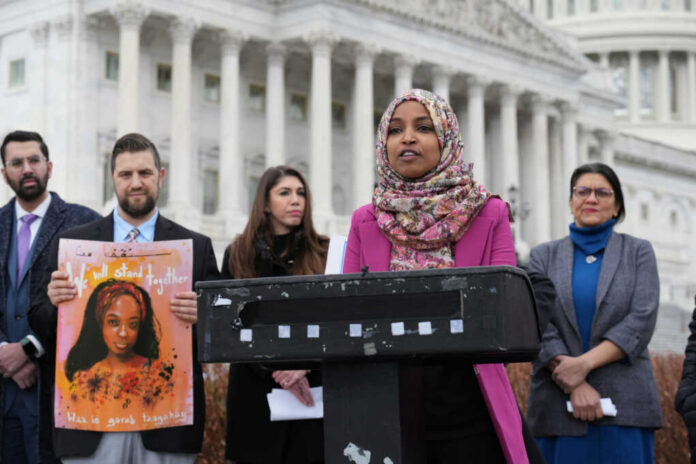
A $30 million “accounting error” on Rep. Ilhan Omar’s financial disclosure is reigniting a core question voters on both sides keep asking: who in Washington is really being honest about money and power?
Quick Take
- Rep. Ilhan Omar amended a financial disclosure after a filing appeared to show $6 million to $30 million in joint assets tied to her husband’s businesses.
- The corrected disclosure listed far smaller assets—roughly $18,004 to $95,000—after liabilities were added, reportedly reducing the companies’ net value to zero.
- The Office of Congressional Ethics requested information, and House Oversight Republicans pressed Omar’s household for explanations as the valuation swung dramatically.
- Video of a reporter confrontation circulated after the amendment, adding political heat to an already polarized debate over transparency and accountability.
A Disclosure Swing Too Big to Ignore
Rep. Ilhan Omar of Minnesota amended her 2025 financial disclosure after her initial filing appeared to show joint assets with her husband, Tim Mynett, valued between $6 million and $30 million. The headline numbers were linked primarily to Mynett’s companies, including eStCru LLC and Rose Lake Capital. In Congress, where disclosure mistakes do happen, a swing of this size stands out because it raises basic accountability questions even before anyone claims wrongdoing.
After the amendment, Omar’s reported assets fell to a range of about $18,004 to $95,000. Her office attributed the discrepancy to an accountant’s error that omitted business liabilities, which would reduce net valuation—potentially to zero—once properly included. The amended filing also included other details reported publicly, including income from assets and listed debts such as student loans and credit card obligations, reinforcing that the revision was not a minor typo.
What Republicans Are Asking—and What’s Still Unclear
House Oversight Republicans, led by Chair James Comer, questioned how a dramatic change could appear in a required disclosure without being caught earlier. The Oversight push also included Minnesota Rep. Tom Emmer, who has cited the episode as part of broader concerns about ethics and disclosure compliance. Separately, the Office of Congressional Ethics requested more information, which is a key procedural detail because it helps explain why an amendment was filed when it was.
Based on available reporting, there is no public finding that Omar committed fraud, and the core documented fact is that a filing was changed after scrutiny. Still, the episode highlights a recurring Washington problem: high-ranking officials often lean on professional staff to explain away errors that would trigger real consequences in the private sector. For voters already skeptical of “rules for thee, not for me,” a massive valuation swing invites tougher demands for receipts, documentation, and plain-English explanations.
The Viral Moment That Turned a Paperwork Issue Into a Political Fight
The controversy escalated further after video circulated showing Omar clashing with a reporter who pressed her about the discrepancies. In the clip described in reports, Omar insults the questioner and refuses to offer further clarification. That reaction matters politically because it shifts the story from technical compliance to public trust. When an elected official responds with contempt rather than transparency, critics interpret it as arrogance, while supporters see hostile media tactics.
Why This Resonates Beyond One Lawmaker
For conservatives, the story fits a broader frustration with elite institutions that appear insulated from consequences, especially when large sums and confusing paperwork are involved. For many liberals and independents, it still raises a simpler question: if members of Congress can file disclosures with multi-million-dollar swings and then blame an accountant, is the disclosure system actually protecting the public? Either way, the underlying issue is the same—confidence that federal watchdog systems work consistently.
With the amended filing now public and no further action reported as of late April 2026, the next developments will likely depend on whether watchdogs or congressional investigators request documentation that substantiates the liabilities cited as the reason the companies’ net value dropped. If that support is produced, the story may fade as a cautionary tale about sloppy compliance. If it is not, it will remain political fuel in an era when Americans increasingly suspect the system protects insiders first.
Sources:
Ilhan Omar’s office says she’s not a millionaire after $30M filing revised to $100K: report
Ilhan Omar financial disclosure amendment accountant error