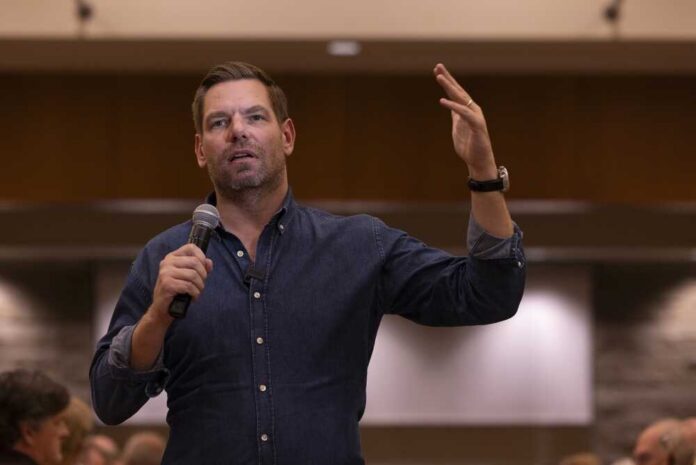
A Democratic gubernatorial frontrunner is facing a sexual-assault allegation built largely on anonymous sourcing—right as California’s primary heats up.
Quick Take
- A former staffer alleged sexual assault by Rep. Eric Swalwell in a report that cited an unnamed source and provided limited publicly verifiable detail.
- A progressive activist amplified additional misconduct claims and said multiple women contacted her, but no additional accusers have publicly identified themselves with evidence.
- Swalwell’s campaign flatly denied wrongdoing and argued the timing points to political smears as rivals press the issue in the governor’s race.
- No public records cited in the research show a police report, lawsuit, or official investigation tied to the new allegation as of April 11, 2026.
What the allegation says—and what is still unverified
A San Francisco Chronicle report set off the latest wave of headlines by quoting an unnamed former congressional staffer who accused Rep. Eric Swalwell (D-Calif.) of sexual assault. The woman reportedly worked with Swalwell beginning on his 2019 presidential campaign and later in his Bay Area district office for nearly two years. As of April 11, coverage referenced in the research has not produced publicly named accusers, documents, or independent corroboration.
That lack of verification matters because “more accusers” can mean very different things in politics: additional on-the-record complainants, additional anonymous accounts, or simply more people contacting activists and campaigns behind the scenes. The research indicates the only detailed assault claim being widely repeated traces back to a single anonymous interview, while other claims circulating online remain generalized and not backed by publicly reviewable evidence.
How the story became campaign ammunition in a tight primary
California’s June 2026 gubernatorial primary uses a top-two system, and the research frames Swalwell as a frontrunner in a crowded field. That context helps explain why Democratic rivals quickly seized on the report. Antonio Villaraigosa criticized Swalwell publicly, and Katie Porter called the allegations “troubling” while expressing support for women who might speak out. The political reality is simple: damaging headlines—verified or not—can reshape early voting.
Swalwell’s campaign responded by categorically rejecting the allegations and portraying them as an election-timed hit driven by opponents and “MAGA conspiracy theorists,” according to the research summary. Those are strong claims, but they do not answer the central question voters typically want resolved in cases like this: what happened, when, and what evidence exists beyond anonymous accounts. At the same time, rivals’ statements are also political messaging unless they are paired with clear substantiation.
The activist angle: viral posts, anonymous DMs, and credibility gaps
Separate from the Chronicle report, political activist Cheyenne Hunt—described in the research as an executive director at Gen-Z for Change and a former staffer—amplified accusations of a broader “pattern,” including claims involving unwanted advances and non-disclosure agreements. The research states Hunt shared an anonymous DM alleging misconduct and later said multiple women contacted her with similar experiences. As of the timeline provided, none of those additional women had publicly identified themselves with evidence.
This is where modern politics collides with due process. Conservatives often argue that reputations can be destroyed through viral allegations without the protections Americans expect in serious accusations. Many liberals counter that power dynamics in politics can silence victims and that anonymity is sometimes the only way to come forward safely. Based on the research provided, the current public record remains thin—meaning citizens are being asked to draw conclusions without the kind of transparent facts that should settle a matter this serious.
Why this story feeds broader distrust in government—left and right
The bigger takeaway is not just the fate of one candidate, but how these cycles deepen public cynicism about institutions. When allegations surface through campaign-season leaks and social-media amplification—and when the public cannot see hard evidence, formal complaints, or clear investigative steps—many Americans conclude the system is built for insiders. For conservatives already skeptical of elite political protection, the question becomes whether accountability is selective or performative.
Breaking: More Sexual Assault Accusers Against Rep. Swalwell Come Forwardhttps://t.co/4sqTNx0zFj
— RedState (@RedState) April 11, 2026
For voters trying to stay grounded, the most responsible posture is to separate what is alleged from what is proven. The research does not cite a lawsuit, police report, or confirmed investigation tied to the latest accusation as of April 11, and it also notes Swalwell’s blanket denial. If more on-the-record accusers emerge or any official process begins, the story changes quickly. Until then, California’s race is absorbing a national-level scandal narrative without nationally visible verification.