President Trump’s Oval Office bell-ringing tied Wall Street’s biggest names to a new federal child savings program that opens with a $1,000 Treasury seed.
Quick Take
- Trump Accounts officially launched on July 4, 2026, the 250th anniversary of the nation.
- The Treasury Department says eligible children born between January 1, 2025, and December 31, 2028, get a $1,000 deposit.
- Nasdaq and the New York Stock Exchange marked the rollout with a joint opening bell from the Oval Office.
- Families can add up to $5,000 a year, and the program drew more than 6 million sign-ups before launch.
Wall Street Joins a Federal Rollout
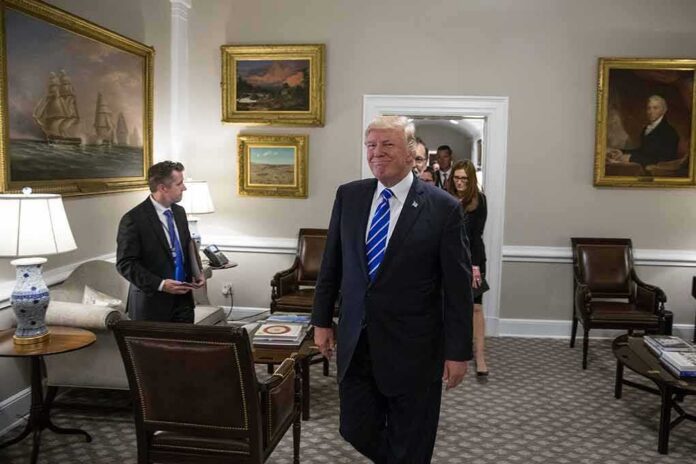
The White House used a rare stock market ceremony to sell the launch of Trump Accounts. Kevin Hassett said Nasdaq and the New York Stock Exchange would ring the opening bell from the Oval Office to mark the start of the program. The event turned a federal savings rollout into a public show of force, with the administration framing it as a major step for children’s long-term financial security.
The Treasury says the program gives every eligible child born in the covered window a $1,000 starter contribution. The money is set to be invested automatically in an index fund, and parents can open accounts for other children under 18 as well. The official site says the goal is to help families build savings early, while the administration says the program can grow into a larger private and public investing habit.
What Families Can Put In
The contribution rules are broad, but they are not unlimited. Treasury guidance says family members, employers, and others can add up to $5,000 a year to each account starting July 4. Other reporting says parents, grandparents, and employers can fund the accounts under those limits, which gives the program a wider reach than a simple one-time deposit. That structure makes the accounts look more like a long-term savings tool than a short-term benefit.
The launch also arrived with strong demand. The Hill reported that more than 6 million families had signed up through IRS Form 4547 before the start date. That early sign-up number suggests the pitch resonated with parents who want a dedicated account for their children. It also shows why the administration pushed the rollout hard on Independence Day, using the holiday to connect the policy to the country’s 250th anniversary and a broader message about ownership and self-reliance.
What the Program Means for Parents and Taxpayers
The most important policy point is simple: this is not free money with no federal cost. The Treasury has committed a direct $1,000 deposit for each eligible newborn in the covered years. That means the government is not merely blessing private saving. It is financing the first step itself. For conservatives who want honest accounting, that matters. A program can still be useful, but it should not be sold with slogans that ignore its real public expense.
FOR THE FIRST TIME FROM THE OVAL: President Donald J. Trump rings the NYSE and Nasdaq opening bell to officially launch https://t.co/se7180V2pt!
Investing in America's next generation! 💰🇺🇸
— karen Hopps (@Hopps00156) July 6, 2026
The administration is presenting Trump Accounts as a pro-family, pro-investment tool that helps children start early. Supporters can fairly say the design encourages saving, private ownership, and more responsibility than another handout. Critics may still point to the federal seed money and ask whether Washington should be in this business at all. The bigger fight now is not whether the program launched. It did. The real question is whether it grows into a genuine asset-building policy or another promised fix from Washington that slowly expands beyond its first limits.
Trump ringing both the NYSE and Nasdaq opening bells from the Oval Office to launch Trump Accounts is historic. $1,000 Treasury seed for eligible kids + billions in private investment to build real generational wealth. This is America First economics in action — creating owners,…
— Donald J Trump The Service Dog (@Donnie4Veterans) July 6, 2026
Sources:
youtube.com, home.treasury.gov, washingtonexaminer.com, thehill.com, apnews.com