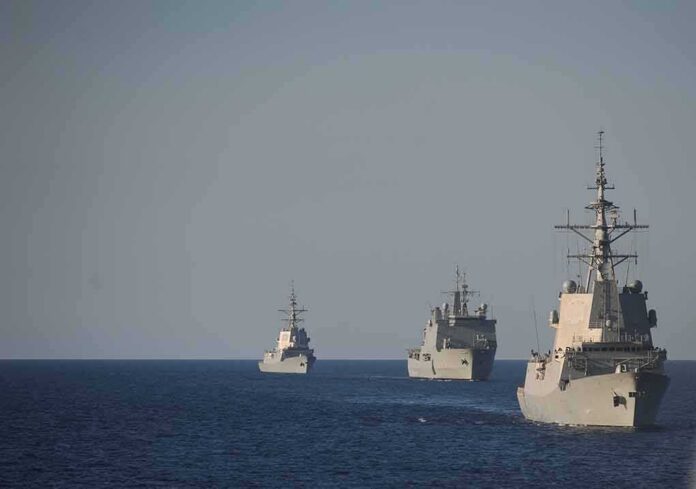
Iran’s rulers are openly tying the Strait of Hormuz to a $300 billion payoff and U.S. concessions, pushing a vital waterway into hostage politics.
Story Snapshot
- Iranian officials link reopening Hormuz to compensation, sanctions relief, and U.S. force changes.
- Reporting describes a $300 billion financing mechanism tied to talks; U.S. insists taxpayers won’t fund it.
- China pressures for safe passage, highlighting Beijing’s leverage over Tehran’s oil lifeline.
- U.S. leaders warn Iran’s tolls or control would set a dangerous global precedent.
Iran Conditions Passage on Massive Payout and U.S. Concessions
Iran’s Revolutionary Guard and senior figures have said the Strait of Hormuz will reopen only if the United States meets Tehran’s conditions. Those conditions include compensation tied to war damage, lifting sanctions, releasing frozen funds, and changing the U.S. military footprint near Iran. This stance turns a global trade artery into a bargaining chip. It raises energy costs for families everywhere and tests whether hostile regimes can tax or block the world’s oil routes by threat.
Reports from the talks describe a framework that features a $300 billion fund connected to Iran’s reconstruction and development needs. Outlets emphasize that the mechanism is not a U.S. Treasury check but a private-sector financing pool, with Washington signaling that American taxpayers will not foot the bill. Even so, the figure is central to debate and gives Tehran leverage while ships wait and markets react. The distinction between “reparations” and “investment” matters for U.S. policy and voter trust.
Confusion Over The $300 Billion: Reparations Or Financing Vehicle?
Leaked-draft coverage and diplomatic briefings present conflicting pictures of the $300 billion. Some Iran-linked claims frame it as compensation; others call it a private investment vehicle with licenses and waivers that enable projects over time. The lack of a signed, public legal text leaves room for spin on all sides. For readers, the bottom line is simple: Iran is using closure pressure to extract money, relief, and control while the United States seeks a path that avoids direct taxpayer funding and restores navigation.
Iranian demands reportedly reach beyond money. Summaries from regional outlets say Tehran wants rapid lifting of a maritime blockade, a defined U.S. force pullback near Iran, and reopening under arrangements coordinated with Tehran. Such terms would mark a major shift in who sets rules at the chokepoint. That shift would reward coercion and risk normalizing tolls or “service fees” for vital lanes worldwide. The United States has long opposed that model for good reason: it punishes lawful commerce and emboldens future blackmail.
China’s Leverage Shows How Energy Politics Are Shifting
China buys most of Iran’s oil exports and has urged all sides to keep ships safe through the strait. Analysts note Beijing’s strong interest in open Gulf shipping and its growing sway over Tehran’s choices. That pressure matters. If China pushes Tehran to reopen, traffic may resume sooner. But a reopening that bakes in special treatment for favored countries and “fees” set in back rooms would still undermine fair passage. Americans would pay more at the pump while hostile powers gain clout over routes we all need.
🛢️ The European economy and the DAX are more sensitive to an oil shock than the Nasdaq. That's why Brent climbing above $84 is capping the strength of the European open.
🌍 Iran / Hormuz — the day's most critical geopolitical topic
The weekend optimism was not fully confirmed.…
— PipMoment (@pipmoment) August 10, 2026
U.S. officials and allies warn that letting Iran control or tax passage sets a dangerous precedent. Secretary of State Marco Rubio told Asian leaders that demands to control and collect tolls in Hormuz threaten the world economy and could be copied elsewhere. The message is clear: if Iran gets paid to reopen, others will try the same play. That is why any deal must restore free navigation without ransom and must not hand Iran a veto over who sails and on what terms.
What To Watch Next: Navigation, Funding Terms, And Rule Of Law
Americans should track three points. First, watch whether ships actually move and under what rules. True reopening means safe, toll-free passage for all lawful traffic, not carve-outs for friends. Second, nail down how the $300 billion works. If funds are private and tied to real projects with clear oversight, that is one thing; if they mask payoffs or political slush, that is another. Third, insist on accountability for any sanctions waivers and licenses to ensure they do not bankroll Iran’s aggression.
President Trump’s team faces a hard balance: lower energy prices and avoid war, while not rewarding extortion. That balance demands unity at home and pressure abroad. Work with allies to keep lanes open, use targeted sanctions to hit Iran’s power centers, and refuse permanent concessions that let Tehran profit from chaos. Free seas, not paid passage, must be the standard. America’s strength, and family budgets across this nation, depend on it.
Sources:
facebook.com, reuters.com, ynetnews.com, youtube.com, npr.org, uscc.gov, cnbc.com