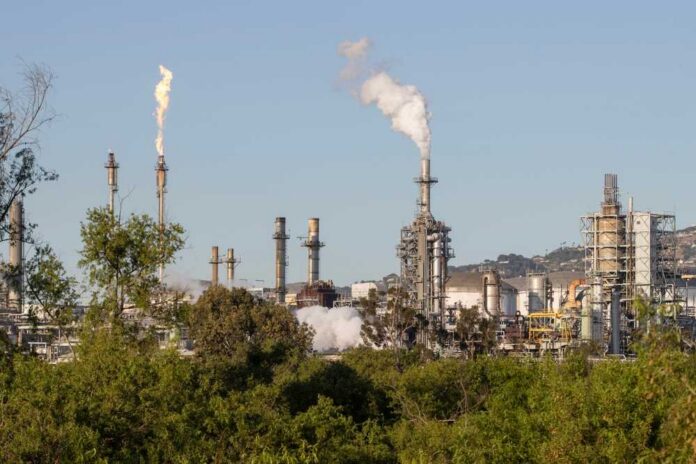
California’s war on its own energy supply is now colliding with reality as refinery shutdowns set the stage for more pain at the pump.
Quick Take
- Phillips 66 shut its Los Angeles-area refinery in December 2025, and Valero plans to idle its Benicia refinery by April 2026—removing roughly 17–18% of California gasoline supply.
- California’s crude oil output has fallen about 65% since 2001, and regulators effectively froze many drilling permits for about five years.
- State-specific fuel rules and geography make California an “energy island,” limiting easy replacement supplies from other U.S. refineries.
- Economists and state officials are discussing converting closed refineries into fuel import terminals, but timing, permits, and infrastructure remain major unknowns.
Two major refinery exits sharpen California’s supply squeeze
Phillips 66’s closure of its Los Angeles-area refinery in December 2025 and Valero’s plan to idle its Benicia refinery by April 2026 remove a large chunk of in-state gasoline production in a short window. Reports cited those two facilities together as roughly 17–18% of California gasoline supply, with Benicia alone associated with about 10%. That loss matters because California still consumes tens of millions of gallons of gasoline per day and cannot quickly replace refining capacity.
Nightmare hurdles oil bosses face in California – as experts reveal when gas prices will fall https://t.co/XEvcHpCZbg pic.twitter.com/Qc6z6YqxWE
— New York Post (@nypost) March 16, 2026
California’s vulnerability is amplified by its specialized gasoline blend and strict environmental requirements, which limit substitution options when local supply falters. Even when global markets are relatively calm, a single unplanned outage at one of the remaining refineries can trigger localized price spikes. With only seven operational refineries left—down from 15 historically—each remaining plant carries more of the burden. That is why the immediate issue is less about ideology and more about basic math: less capacity means tighter supply.
Regulatory pressure and declining crude production compound the problem
California’s crude production decline did not happen overnight. Research in the provided materials describes a roughly 65% drop from 2001 to 2025, falling from over 760,000 barrels per day to about 250,000. At the same time, the state became more dependent on imports—nearly 400 million barrels annually—while regulators at CalGEM effectively froze drilling permits for about five years. Reduced in-state crude and fewer permits make it harder to sustain the upstream side of the system.
Refiners and industry groups also pointed to rising compliance costs tied to California Air Resources Board policies, including “cap-and-invest” amendments that increase the cost of emissions allowances. Marathon Petroleum and Chevron publicly warned that rule changes could make operations uneconomic, which they argued would accelerate closures and raise fuel prices. Those warnings are advocacy, not neutral forecasting, but they align with the observable trend: companies are exiting while the state still depends heavily on gasoline for daily life.
California’s “energy island” problem: imports aren’t a simple fix
California is often described as an “energy island” because it is not easily plugged into the broader U.S. refining network. Geography, limited pipeline pathways, and the state’s unique fuel specifications mean that gasoline from other states cannot always be shipped in quickly or cheaply. The research notes California has imported refined products from as far away as the Bahamas, India, and South Korea. Greater reliance on distant imports can add shipping costs, increase exposure to disruptions, and reduce resilience during emergencies.
For families and small businesses, this translates into a familiar pattern: the state sets aggressive deadlines to phase out fossil fuels by 2045, but the alternative system is not yet capable of carrying the load. Electric vehicle adoption may grow, but the materials provided do not quantify a near-term rate that would reliably offset a sudden 17–18% refinery capacity loss. Without that hard bridge, consumers remain stuck paying for policy risk, supply risk, and a complex import supply chain.
When could gas prices fall—and what has to happen first?
The research points to a “mid-transition” period where California tries to keep fuel available while policy pushes toward lower fossil-fuel use. One proposed pressure-release valve comes from Stanford-affiliated economists: converting shuttered refineries into fuel import terminals so gasoline can still flow into the state even after processing stops. Governor Gavin Newsom’s administration has discussed working with Valero on continued imports into Northern California after Benicia idles. This approach could reduce shortages, but it depends on permitting and buildout timelines.
As for when prices could fall, the honest answer from the materials is that it hinges on variables California cannot fully control: the success and speed of import-terminal conversions, the stability of global refined-product supply, and whether additional refineries stay open. Research also notes that profit-cap rules remain on hold until 2029, suggesting ongoing policy uncertainty for the industry. Without clear signals that supply will be stable, consumers should expect continued volatility rather than a clean, predictable decline.
Nightmare hurdles oil bosses face in California — as experts reveal when gas prices will fall Although President Donald Trump issued an executive order Friday to resume offshore drilling in California, don’t expect to see prices at the pump drop anytime … https://t.co/tdrQD479pL pic.twitter.com/LnXt504S1G
— NahBabyNah (@NahBabyNahNah) March 16, 2026
For conservatives watching from outside California, the broader lesson is straightforward: energy security is a prerequisite for affordability and economic stability, not a luxury item. The evidence in these sources shows a state reducing in-state production and refining capacity faster than it is reducing demand. That mismatch creates the conditions for price spikes, import dependence, and political blame-shifting when the predictable happens. If policymakers want lower prices, the near-term requirement is reliable supply—regardless of the long-term transition debate.
Sources:
California oil industry regulation
Can California’s oil industry survive?
California’s energy crisis: why oil
Fuel volatility, refinery closures, and how California businesses can prepare for 2026
State of California oil 2026: accountability for oil companies is so much bigger than Newsom
Supplemental background: why California refineries are closing (Stanford CEPP PDF)
Why California’s rising gas prices are a threat to national security