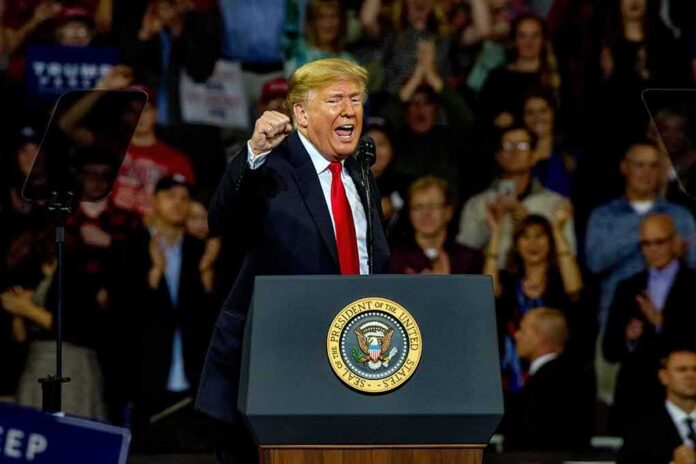
As President Trump tightens his grip on the Republican Party heading into the midterms, voters must decide whether this unity machine will deliver bigger majorities or expose costly weak spots in swing territory.
Story Snapshot
- Trump’s endorsements dominate Republican primaries, often deciding who carries the party banner into November.
- Political researchers find a Trump endorsement can slightly reduce a candidate’s appeal with the broader electorate in general-election matchups.
- Past midterms showed Trump-backed candidates winning many primaries but underperforming expectations in November.
- Republicans now face a strategic choice: maximize loyalty to Trump or fine-tune where and how his brand is deployed.
Trump’s Dominance Over Republican Primaries Is Undeniable
News coverage of recent primaries shows that President Trump’s endorsement remains one of the most powerful forces inside the Republican Party. In Kentucky, Trump-backed challenger Ed Gallrein defeated Representative Thomas Massie in a costly primary, underscoring how aligned candidates can topple even well-known incumbents when the base follows Trump’s lead.[2] Similar stories in Texas and other states show that once Trump signals a favorite, many primary voters rally behind that candidate.[2][3] For conservatives, this has delivered nominees who clearly oppose the left’s agenda.
Reports on other key races describe Trump-endorsed candidates advancing in contests that were framed explicitly as tests of his control over the Republican Party.[2][3] Party activists, tired of weak-kneed politicians who cave on border security, energy dominance, or stand silently while the left attacks parents and gun rights, have used Trump’s endorsements as a shortcut for identifying fighters. That influence keeps the party from drifting back toward the old establishment that too often compromised away core constitutional and family values.[3] But the same strength raises a strategic question about November.
Evidence That Trump’s Brand Plays Differently In General Elections
Political scientists studying voter behavior have tested how a Trump endorsement affects general-election support. One survey experiment found that when a hypothetical Republican candidate was explicitly endorsed by Trump, overall support for that candidate dropped by about four percentage points in a general-election scenario.[1] Among Democrat voters, support fell much more sharply, by roughly eleven points when Trump’s backing was mentioned.[1] Those findings suggest that while Trump energizes Republicans, his label can harden opposition among Democrats and some persuadable voters.
That pattern appears to echo past midterm results. A research scorecard on Trump’s midterm endorsees found that, out of seventy-five House and Senate candidates he supported, forty-two won their races, a win rate of about fifty-five percent.[4] That is not failure, but analysts noted these candidates underperformed broader Republican expectations once all factors were considered.[4] In other words, Trump’s picks did well enough to prove his clout, yet not so well that critics could be dismissed when they warned about leaving swing districts vulnerable in November.
Party Unity Versus November Electability In Swing Districts
Axios reporting describes how Trump has worked to “stamp out” messy primaries by endorsing early and heavily, backing roughly ninety-five percent of House Republicans and large shares of Senate candidates in competitive states.[6] The goal is to prevent expensive internal fights that drain money and give Democrats opposition research, while presenting a unified, Trump-aligned ticket into the fall.[6] For many grassroots conservatives, this is long overdue discipline after years of establishment infighting and surrender on spending, globalist trade deals, and border chaos.
However, political science research on nominating fights shows a long-running tension between pleasing primary activists and winning the middle in November.[1] Trump’s current strategy magnifies that tension: his endorsement is gold with the Republican base but can slightly dampen general-election appeal in closely divided districts.[1] If every nominee is tightly tied to Trump, the party maximizes unity and clarity on issues like immigration, school choice, and law and order—but it also gives Democrats a simple, nationalized message in swing suburbs that still consume corporate media attacks on Trump.
How Conservatives Can Turn Trump’s Power Into A Midterm Asset
For conservative voters who back Trump’s America First agenda, the challenge is not whether Trump should lead the party—he already does—but how that strength is deployed district by district. The evidence indicates his endorsement helps ensure that nominees actually believe in secure borders, parental rights, and rejecting woke cultural engineering, rather than mouthing talking points during campaign season.[2][3][6] That ideological clarity protects the movement from candidates who would return to business-as-usual once in Washington.
These primaries have been good testing grounds for how strong a Trump endorsement is for a race along with the effectiveness of different state GOP ground games and orgs like TPUSA especially with Indiana. Strong wins and experience that can be used in the runoffs and midterms
— CheeseburgerSpeculator (@SpeculateBorgar) May 20, 2026
The same evidence also warns that Republicans cannot simply rely on Trump’s name to carry tough general elections.[1][4] In swing areas, candidates may need to pair Trump’s backing with relentless focus on kitchen-table issues: high energy costs, inflation fueled by old spending binges, crime, and the left’s ongoing attacks on free speech and gun rights. Research does not say Trump must step back; it says his brand should be used smartly, not blindly. If Republicans match his movement energy with disciplined local campaigning, they can turn Trump’s ownership of the party from a midterm risk into the engine of a larger constitutional conservative majority.
Watching Trump get absolutely destroyed in the midterms will be hilarious. That’s not an endorsement of Democrats. Congrats to @EdGallrein on his AIPAC funded win. pic.twitter.com/MDSXfH59Ho
— Cascade County Libertarian Party (@CCLP406) May 20, 2026
Sources:
[1] Web – The Causal Effects of a Trump Endorsement on Voter Preferences in …
[2] YouTube – Trump’s grip on GOP tested in primary elections
[3] YouTube – Key races test Trump’s influence ahead of midterm elections
[4] Web – Trump endorsed 75 candidates in the midterms. How did they fare …
[6] Web – Trump’s ruthless midterm power play – Axios