
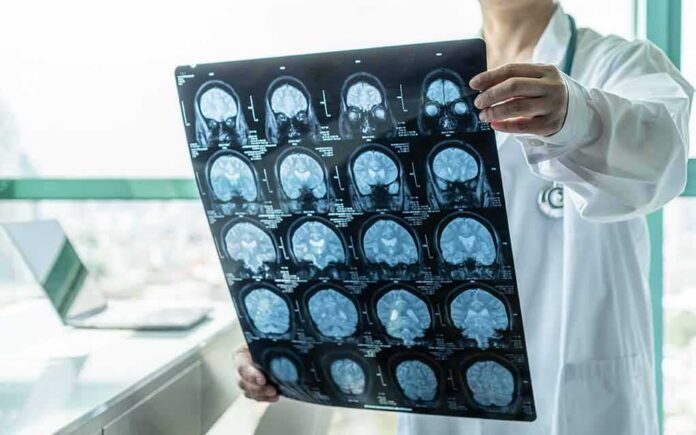
Scientists have adapted an Alzheimer’s brain test to spot signs of CTE, the violent-hit brain disease that has haunted veterans and football players for years, while the patient is still alive.
Story Snapshot
- Researchers funded by the National Institutes of Health adapted a prion-style lab test, called AD RT-QuIC, to hunt for a corrupted tau protein linked to both Alzheimer’s disease and chronic traumatic encephalopathy (CTE).
- The test can find that protein in amounts as tiny as a pinhead dissolved in a thousand gallons of liquid, according to the National Institutes of Health.
- Until now, doctors have had no approved way to confirm CTE in a living patient; the disease could only be verified through a brain autopsy after death.
- The finding offers real hope for veterans and athletes with repeated head trauma, though scientists caution it is early-stage research, not yet a ready-for-market diagnostic tool.
An Alzheimer’s Tool Gets Repurposed for CTE
Researchers backed by the National Institutes of Health built a lab test called AD RT-QuIC to catch abnormal tau seeds tied to Alzheimer’s disease. Tau is a protein that, when it folds wrong, clumps together and damages brain cells. The team found their test also picks up the same rogue tau tied to CTE, a disease long linked to military veterans and contact-sport athletes.
The test works by borrowing a trick from prion disease research, the same family of science used to study Mad Cow Disease. It amplifies tiny traces of misfolded protein until they become detectable, even in samples so dilute they’d normally slip past every lab instrument. The National Institutes of Health says it can spot a pinhead-sized amount of the protein diluted into a thousand gallons of liquid.
Why Living Diagnosis Has Been Out of Reach
For years, families of veterans and former football players have waited for answers that never came. Doctors currently have no approved biomarker to confirm CTE while a patient is alive, and the disease can only be proven through an autopsy after death. That means grieving families often learn the truth too late, and living patients get no clear diagnosis to explain memory loss, anger, or depression.
Boston University researchers have spent years chasing a living test, including experimental brain scans that showed promise but fell short of full accuracy. Separate studies found that tau tangles in CTE fold differently than those in Alzheimer’s, which is part of why building one reliable test for both diseases has been so hard. Scientists say a working test could reshape how the disease is studied and treated.
What This Means for Veterans and Athletes
This research matters most for the people who have carried the risk of CTE for decades: combat veterans exposed to blasts and football players who took repeated hits to the head. A validated living test would let doctors diagnose the disease early, track its progression, and potentially test treatments while patients are still around to benefit. Right now, families are left guessing, and that has real consequences for care and benefits decisions.
Other biomarker studies back up the tau-seed approach. One brain-sample study found that seeding activity in CTE cases matched levels seen in confirmed Alzheimer’s brains, reinforcing that the underlying method has real scientific traction. Advocacy groups focused on brain disease research have said the near-term goal for the field is imaging or fluid tests that can locate tau tangles in a living patient’s brain.
A Promising Step, Not a Finished Product
Nobody should mistake this for a finished diagnostic tool sitting in doctors’ offices tomorrow. The research so far comes from lab samples, not a large-scale clinical trial ready for widespread use. Scientists studying tau biomarkers for years have repeatedly noted that early lab success does not always translate cleanly into a dependable clinical test, and CTE research has seen promising leads fall short before.
Still, this represents forward motion on a problem that has frustrated doctors, veterans, and families for years. A government-backed research agency putting real resources behind a tool that could finally give living patients answers is the kind of practical, results-driven science conservatives want to see funded. Continued work on this test deserves close attention as it moves toward real-world use.
Sources:
sciencenews.org, nih.gov, pubmed.ncbi.nlm.nih.gov, medscape.com, clinicaltrials.gov