
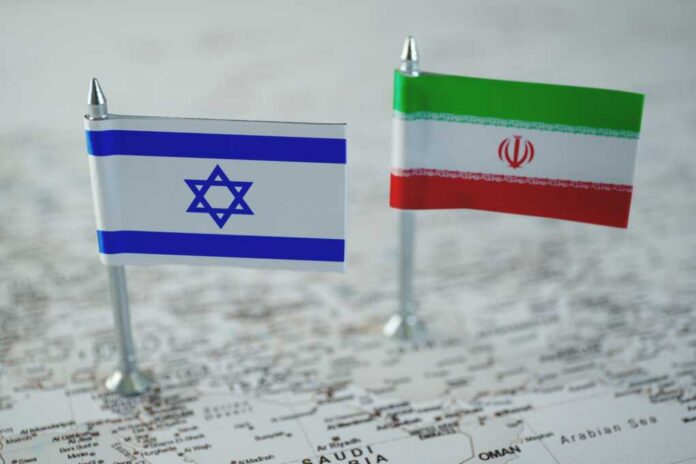
Iran’s missiles reportedly flew toward Israel just minutes after President Trump announced a two-week pause in U.S. strikes—an abrupt test of American deterrence that raises hard questions about whether “ceasefire” means anything to Tehran.
Story Snapshot
- President Donald Trump announced a two-week suspension of the U.S. bombing campaign against Iran, according to reporting summarized by Fox News and Mediaite.
- Fox News correspondent Mike Tobin reported Iran launched missiles at Israel “minutes after” Trump’s ceasefire announcement.
- The rapid sequence suggests a direct challenge to de-escalation efforts and risks pulling Israel and the U.S. back toward retaliation.
- Public details remain limited: the available reports do not include independent confirmation from Iranian or Israeli officials, or specific impact and casualty information.
Ceasefire Announcement Meets an Immediate Missile Test
President Trump announced a two-week pause in U.S. bombing against Iran, framed in available reporting as a ceasefire-style suspension of strikes. Fox News senior correspondent Mike Tobin then described an almost immediate follow-on event: Iranian missiles launched toward Israel “minutes after” the announcement. Mediaite echoed the same basic timeline, reinforcing that the key fact pattern is the unusually tight sequencing between the U.S. pause and Iran’s launch.
The timing matters because it shifts the headline from “de-escalation” to “credibility.” If a U.S.-announced pause is followed by an attack on America’s closest regional ally, Washington’s next steps become less about diplomacy and more about deterrence. For many Americans already skeptical of foreign adversaries and frustrated by years of mixed signals overseas, this is the kind of moment that clarifies whether U.S. restraint is being treated as strength—or exploited as weakness.
What We Know—and What We Still Don’t
The two reporting threads align on the central claim: missiles were launched at Israel shortly after Trump’s announcement of a two-week pause in U.S. strikes on Iran. Beyond that core, the public record in the provided research is thin. No detailed readout is included about interception results, damage, or casualties, and the sources cited do not quote Israeli or Iranian officials confirming the sequence, targets, or operational intent in their own words.
That gap is important for readers trying to separate verified events from the broader narrative that quickly forms online. The reports establish the “when” and the “what” as presented by U.S.-based outlets, but not the full “how” or “why.” In fast-moving security situations, governments may delay statements, and early information can be incomplete. For now, the most defensible takeaway is narrow: a U.S. pause was announced, and missile launches toward Israel were reported almost immediately afterward.
Why Iran’s Timing Pressures U.S. and Israeli Decision-Making
Even without extended background, the immediate strategic implication is straightforward: a ceasefire announcement can become a pressure point rather than a cooling-off period. If Iran (or forces acting under its direction) chooses to strike during a declared pause, Israel faces a dilemma between absorbing attacks, responding independently, or coordinating with Washington while the U.S. has publicly signaled restraint. Each path carries risk, including escalation that the pause was meant to prevent.
The Bigger Pattern: Americans Doubt Institutions, Not Just Adversaries
This episode lands in a political climate where many voters—right and left—believe federal decision-making too often looks reactive, inconsistent, or shaped by insider incentives rather than clear national interests. Conservatives tend to read events like this as proof that adversaries only respect strength and consequences, not carefully worded pauses. Many liberals worry that any response spirals into another open-ended conflict. With the current reporting limited, the public is left to judge the policy signal more than the battlefield facts.
For now, the practical question for Americans is whether U.S. policy can pair restraint with enforceable red lines. Trump’s two-week pause, followed by reported missiles toward Israel, is the kind of stress test that either strengthens deterrence through a measured but firm response—or weakens it if adversaries conclude that announcements carry no cost. Until more independent details emerge, readers should treat sweeping claims cautiously and focus on verified timelines and official statements as they arrive.
Sources:
https://www.foxnews.com/video/6392714296112