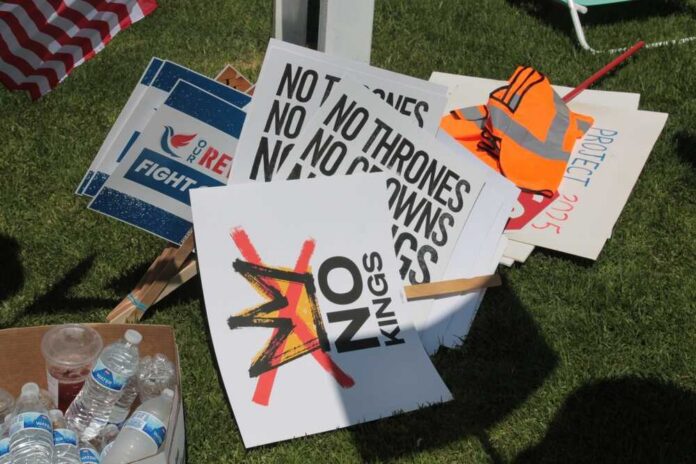
As Americans fight overseas and pay more at home, a fresh wave of “No Kings” protests is reigniting a troubling question: is this movement grassroots dissent—or political theater amplified by hard-left networks and possible foreign-adjacent money?
Story Snapshot
- Major “No Kings” rallies are scheduled again for March 28, 2026, with organizers expecting large crowds in the U.S. and abroad.
- Conservative outlets and Republican investigators point to communist participation and broader “dark money” pipelines as a credibility test for the movement.
- Progressive media and organizers frame the protests as a broad, organic response to Trump-era policies, without emphasizing funding allegations.
- House Oversight Republicans are pressing for documents and a DOJ briefing related to possible foreign-agent registration issues tied to a separate protest/riot funding probe.
What the “No Kings” Protests Claim to Be
Organizers and sympathetic coverage describe “No Kings” as a recurring national protest brand aimed at opposing the Trump administration and what participants view as threats to democratic rights. A March 27, 2026 segment previewed the March 28 rallies as the third major iteration, projecting large participation across the United States and internationally. That framing matters because it positions the events as mainstream civic action rather than niche activism—and it sets up the fight over who is truly steering the message.
For many conservative voters in 2026—already angry about years of inflation, illegal immigration, and bureaucratic overreach—the “No Kings” branding lands differently in the middle of a U.S. war with Iran. Skeptics see an attempt to delegitimize an elected government while the country faces external threats and domestic strain. The movement’s scale and repetition also raise an obvious practical question: who coordinates, pays for travel and logistics, and keeps a national network synchronized?
Communist Participation: Documented, But Not the Whole Story
One of the clearest factual data points is that the Communist Party USA publicly celebrated its participation in “No Kings Day,” presenting itself as part of a wider coalition and highlighting its own role within the protests. Separately, a conservative policy outlet reported that a Twin Cities “No Kings” event was sponsored by the Communist Party, treating that sponsorship as disqualifying rather than incidental. Those claims show ideological involvement, though they do not, by themselves, prove centralized control over every local rally.
The evidence base becomes more contested when critics move from “communists participated” to “the entire movement is funded and managed by communist-aligned networks.” Conservative reporting has circulated sweeping numbers about how many organizations are involved and how much total revenue sits behind aligned activist infrastructure. Those broader financial claims may be directionally plausible in a world of professionalized activism, but the underlying documentation varies by source, and some assertions appear more fully developed than others in the currently available material.
The Neville Singham/PSL Funding Allegations—and What’s Actually Being Investigated
House Oversight Republicans have escalated scrutiny of an alleged funding web tied to Neville Singham, a U.S. tech billionaire now based in China, described by investigators as backing groups connected to unrest in Los Angeles and linked to the Party for Socialism and Liberation. Lawmakers are seeking documents and asking the Department of Justice for a briefing on possible Foreign Agents Registration Act issues. This is a key distinction: the most formal investigative actions described are tied to riot-linked funding questions, not a proven money trail specific to every “No Kings” event.
Even so, the political risk for “No Kings” organizers is obvious: if a protest ecosystem depends on nonprofit pass-throughs, fiscal sponsors, and ideologically aligned coalitions, then any credible evidence of foreign-directed influence or coordination could quickly taint the whole brand. Conservatives who already distrust “dark money” activism see a national-security angle as much as a culture-war one—especially with China tensions high and the country already committed militarily abroad.
Why This Matters to Constitutional Conservatives in 2026
Americans do not lose their First Amendment rights because a protest message is obnoxious, coordinated, or ideologically extreme. The constitutional line is not “are they protesting,” but whether organizations are transparently following U.S. law—especially if foreign nationals or foreign-directed entities are financing political influence activities that require registration and disclosure. A functioning republic depends on lawful dissent and honest transparency, not opaque networks that can launder influence through layers of nonprofits and “grassroots” branding.
No Kings protests reportedly funded by socialist, communist groups – https://t.co/9peccv2Xqn – @washtimes
— Barrel O'Neil (@neilproof110) March 28, 2026
With the Iran war sharpening public distrust of elite decision-making, conservatives are also watching whether domestic unrest becomes a tool to pressure the administration into wider crackdowns, emergency measures, or speech-policing. Limited government advocates should demand two things at once: protect peaceful protest rights, and enforce transparency laws equally. The unanswered question heading into March 28 is whether investigators can produce concrete, event-specific funding documentation—or whether the debate stays stuck between ideological accusations and media counter-framing.
Sources:
CPUSA Joined the Millions on No Kings Day
Twin Cities “No Kings” event is sponsored by the Communist Party
No Kings Day March 28 (Democracy Now, March 27, 2026)
Oversight Republicans Investigate Funding Behind Los Angeles Riots Linked to Chinese Communist Party