
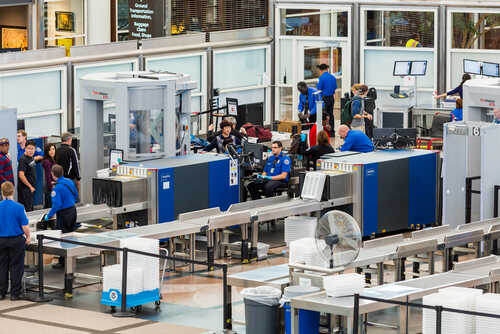
Washington’s immigration fight has spilled straight into America’s airports—leaving unpaid TSA screeners, hours-long security lines, and a DHS shutdown dragging into its second month.
Quick Take
- DHS has operated without appropriated funding since mid-February 2026, disrupting airport security operations during spring break travel.
- Over 100,000 DHS employees have faced delayed or missed paychecks, while TSA screeners have reported partial checks followed by zeroed-out pay.
- Major airports have seen severe security backups, including reports of three-hour waits at a Houston-area airport and hour-plus lines in other hubs.
- The Senate has failed repeatedly to advance a full DHS funding bill, reflecting a stalemate tied to conditions on ICE and CBP.
- More than 300 TSA agents have reportedly quit during the shutdown, and TSA leadership has warned airport closures could become necessary if callouts worsen.
Shutdown Gridlock Hits Travelers Where It Hurts: The Checkpoint
DHS funding lapsed in mid-February 2026, and the consequences are now most visible at TSA checkpoints. Spring break demand has collided with staffing instability and financial stress on screeners who are still showing up. Reports from early March described consistent three-hour waits at a Houston-area secondary airport, while travelers in cities like New Orleans and Atlanta have faced lines exceeding an hour.
Transportation security is not a “nice-to-have” function that can be paused without fallout. When checkpoints slow down, families miss flights, businesses lose time and money, and public confidence erodes. The situation also creates a basic fairness problem: federal workers are effectively being used as shock absorbers for a political stalemate, even as travelers pay the price in delays and cancellations.
Unpaid Federal Workers and a Shrinking TSA Workforce
The shutdown has strained household budgets for federal employees, with more than 100,000 DHS workers affected by delayed or missed pay. Reporting has described TSA screeners receiving partial paychecks where deductions still went out, followed by pay that was effectively zero. A small portion of DHS staff has been furloughed, but many “essential” roles have continued without normal compensation.
Staffing pressure has moved from inconvenience to operational risk. More than 300 TSA agents have reportedly quit since the shutdown began, worsening shortages at the exact moment passenger volume surges. TSA leadership has warned that if callouts continue to climb, airport closures may become necessary. That warning underscores how quickly a funding lapse can turn into a national bottleneck affecting security, commerce, and the daily lives of ordinary Americans.
Why Congress Is Stuck: ICE and CBP Conditions Drive the Impasse
The dispute is not simply about whether to fund DHS in the abstract, but about conditions tied to immigration enforcement agencies. Earlier in 2026, bipartisan negotiators had discussed a DHS package that included $20 million for body-worn cameras for immigration enforcement agents and additional de-escalation training resources. That balance unraveled after a January shooting in Minnesota involving DHS law enforcement personnel.
After that incident, Democrats pushed for what they called “basic accountability measures” for ICE and CBP as a condition for funding. Republicans, led by Senate Majority Leader John Thune, have argued for fully funding DHS without restrictions that would limit enforcement capacity. The back-and-forth has produced a familiar Washington pattern: each side claims the other is refusing to negotiate, while the public sees the results in longer lines and missed flights.
Votes Keep Failing, and Partial-Funding Proposals Aren’t Breaking Through
The Senate has taken multiple failed votes on DHS funding as the shutdown persists. A mid-March vote on a Republican bill to fund all of DHS failed to reach the 60 votes needed to advance, and Democrats have blocked full-funding efforts repeatedly since the lapse began. Republicans, in turn, have blocked a Democratic approach that would fund non-immigration components while leaving ICE and CBP unresolved.
The White House has urged Congress to restore full operations, with press messaging emphasizing that TSA, FEMA, and the Coast Guard should not be used as leverage. House Democrats have argued for a targeted bill funding agencies like TSA and the Secret Service while the immigration dispute continues. Based on available reporting, the core uncertainty is not whether the shutdown is disruptive—it clearly is—but whether either party is willing to accept a deal that doesn’t fully satisfy its demands on immigration enforcement.
Sources:
Senate Democrat shutdown fuels airport disruptions, heightens security risks
White House, Democrats trade blame for missed paychecks and airport delays
Lawmakers vent frustration over DHS shutdown as lines grow at nation’s airports
Senate fails to advance DHS funding bill
Democrats push partial funding for DHS as thousands of federal workers go unpaid