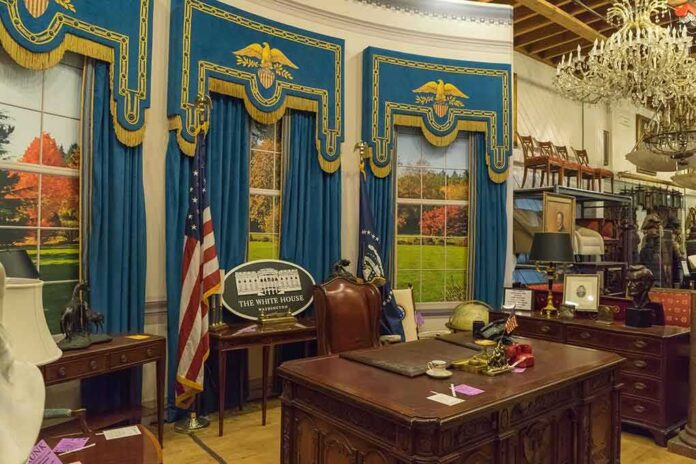
President Trump used the Antiquities Act to declare the Oval Office a national monument, locking in safeguards for America’s most symbolic workspace.
Story Highlights
- Trump signed a proclamation creating the Oval Office National Monument, including the Cabinet Room.
- The designation orders preservation and review before major changes or demolition.
- The proclamation cites the Antiquities Act as the legal basis for the monument.
- The move protects historic character while allowing normal redecorating and security updates.
Trump Creates Oval Office National Monument Under Federal Law
President Trump signed a proclamation on November 5, 2026, establishing the Oval Office National Monument. The designation covers the Oval Office, the Outer Oval Office, and the Cabinet Room within the West Wing. The proclamation cites section 320301 of Title 54, known as the Antiquities Act, as the authority for protecting nationally significant federal spaces. The White House described the action as a preservation step tied to the office’s history, architecture, and link to the presidency.
The proclamation directs the Secretary of the Interior to manage the new monument through the National Park Service. It sets clear goals: protect historic character, guard architectural integrity, and preserve the space’s association with the presidency. It also requires officials to document and review options before any substantial alteration or demolition. That procedure creates a formal check against sweeping changes that could erase national heritage inside the seat of executive power.
What Is Covered And What Remains Allowed
The proclamation’s scope lists the Oval Office itself, the Outer Oval Office, and the Cabinet Room by room number. The policy allows presidents to redecorate, choose furnishings, and make ordinary operational and security upgrades. It focuses restrictions on major structural changes that would substantially impair the rooms’ historic qualities. That balance lets each president adapt the workspace for daily duties, while keeping America’s most visible office stable for future generations and civic memory.
The White House fact sheet explains that officials must review any proposal that would lead to substantial alteration or demolition. The requirement encourages documentation, alternatives analysis, and alignment with the rooms’ national significance. The approach resembles common sense stewardship: routine changes move ahead, while heavy construction faces a preservation test. The text does not cite a specific demolition threat, but it installs a durable process to prevent rash or sweeping redesigns down the road.
Why The Antiquities Act Was Used Here
Presidents have used the Antiquities Act for more than a century to protect landmarks, structures, and objects on federal property. Trump’s proclamation applies that tool to the executive complex’s most famous rooms, citing their unique history and design. The Oval Office’s oval shape dates to President William Howard Taft and was refined in the early 1930s, reflecting both ceremony and function. The law’s use inside the White House underscores that national heritage can exist in working government spaces, not only in distant parks.
Congressional researchers note that the Antiquities Act does not clearly state whether a president can reduce or eliminate a monument, and past practice has seen size reductions but not outright revocations. That history shows monument policy can change with elections, even as it creates real protections. Trump has also adjusted monument boundaries elsewhere to restore practical management. Together, these facts show a familiar pattern: swift executive action followed by debate over durability and scope.
How This Fits Conservative Priorities
This move protects a national symbol from fads, rushed remodels, and politicized makeovers. The policy respects tradition, honors the presidency, and defends a piece of American culture that belongs to the people, not to passing trends. The management rules guard against costly, disruptive overhauls while allowing normal updates that help security and daily work. In short, it secures the people’s House from careless change, and it does so using a lawful, established tool with a narrow, targeted aim.
President Donald Trump has signed a proclamation seeking congressional protection for the Oval Office and Cabinet Room, saying future presidents should need lawmakers' approval before making major structural changes.
The move follows Trump's own renovations at the White House,… pic.twitter.com/yvRqZeKXp6
— World Times (@WorldTimesWT) November 6, 2026
The text leaves daily flexibility where it should be: with the sitting president managing decor, furnishings, and routine fixes. At the same time, it draws a bright line against gutting the room that has heard our wars declared, crises managed, and peace signed. That is a victory for stewardship and national identity. It tells future officials to treat the Oval Office not as a canvas for vanity, but as a trust held for the American family.
Sources:
thegatewaypundit.com, whitehouse.gov