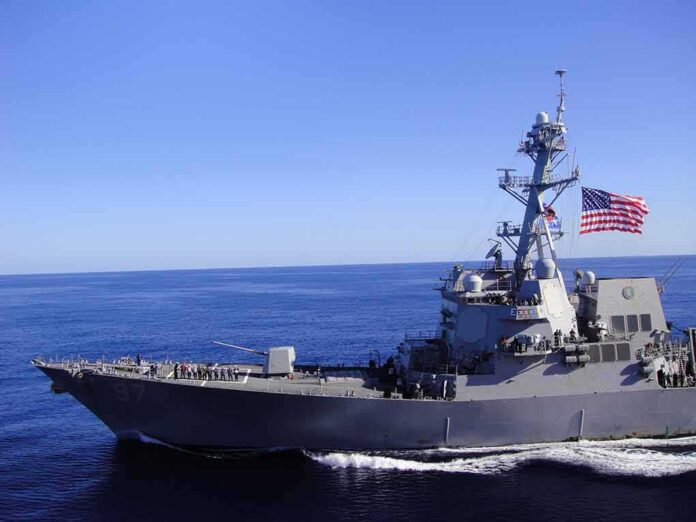
U.S. Central Command says American forces struck three Iranian oil tankers after Iran targeted U.S. Navy ships, sending a clear message that attacks on international shipping will carry a price.
Story Highlights
- CENTCOM said the strikes aimed to protect freedom of navigation and punish Iranian aggression.
- Reports say three Iranian oil tankers were disabled or destroyed after ballistic missiles targeted U.S. warships.
- Officials described a wider campaign hitting more than 80 Iranian military targets tied to maritime threats.
- Iran called the U.S. actions illegal and claimed a ceasefire was violated, but provided no independent proof.
CENTCOM Describes Strikes As Self-Defense To Protect Shipping
U.S. Central Command said American forces completed strikes designed to reduce Iran’s ability to attack ships moving through a key trade route. Command language stressed self-defense and freedom of navigation after Iranian forces threatened vessels near the Strait of Hormuz. The command said recent waves of strikes hit many targets supporting Iran’s maritime attacks, including launch sites and coastal systems that enable harassment of ships, to impose costs and deter future strikes on global commerce.
Major outlets reported the operation followed fresh Iranian attempts to hit U.S. Navy ships. A defense report said Iran fired ballistic missiles at two U.S. warships, which evaded the attack. Soon after, American forces disabled or destroyed three Iranian oil tankers used to skirt a renewed blockade effort and support Iran’s campaign at sea, according to that account. The action was framed as a direct and proportional response to defend U.S. forces and secure the sea lanes.
Scope Of The Campaign And Maritime Security Stakes
Coverage of the broader campaign said U.S. strikes hit more than 80 targets across Iran’s maritime threat network. These included air defenses, coastal radar, and fast-attack boats used to menace tankers, as well as sites tied to missile and drone launches. U.S. officials presented the actions as part of a sustained effort to keep trade flowing through a chokepoint that carries vital energy supplies for the world economy and for American families who feel fuel price shocks first.
U.S. statements also pushed back on Iranian claims of control over shipping lanes. The command said Iran does not control passage through the Strait and has no right to restrict lawful transit. American messaging underscored that the United States will protect its ships and crews, and will not allow Iran’s Revolutionary Guard to turn an international waterway into a toll road for rogue actors. That stance aligns with long-held U.S. policy to keep the sea open for all lawful traffic.
Iran’s Claims And The Legal Backdrop
Iran’s foreign ministry and state outlets called the U.S. strikes illegal and a breach of a ceasefire. They claimed a U.S. air-launched missile hit an Iranian tanker’s engine room and alleged other hostile actions on Iran’s territory. These statements did not come with independent evidence and came through secondary reporting. Tehran vowed to use “all capacities” to respond, raising the risk of more tit-for-tat moves in a region where miscalculation can grow into wider conflict.
Western and academic analyses show why the Strait often turns tense fast. Attacks on ships can reach the level of an “armed attack” that triggers self-defense under international law, depending on scale and intent. That legal frame has guided U.S. policy to deter Iran’s use of missiles, drones, and fast boats to threaten tankers. The United States says its recent strikes meet the test of necessity and proportionality after repeated Iranian attacks on vessels and U.S. ships.
Why This Matters To Americans At Home
Iran’s attempts to choke the Strait can hit your wallet. When oil flows drop or seem at risk, prices climb. Families feel it at the pump and in the cost of goods. The United States argues that swift action to stop attacks helps keep energy moving and prevents longer price spikes. A clear policy also tells hostile regimes they cannot blackmail our economy or our allies by threatening ships in a narrow waterway used by the world.
Tensions are rising in the Middle East following a U. S. attack on an Iranian tanker near Kharg Island, while diplomatic efforts continue in Ukraine. Monitoring remains critical as developments unfold #AIAnalysis #OSINT #Ukraine #Russia #NATO #Iran #Israel #MiddleEast pic.twitter.com/DqolITuuf9
— ORACLE World Risk Intelligence (@Oracle_Intel) September 5, 2026
President Trump’s administration is now fully responsible for protecting American forces and trade routes. Supporters will see these strikes as necessary force to uphold order at sea. Critics will cite escalation risks. What is clear from official accounts is that U.S. warships came under threat and that the Pentagon answered to deter more attacks. The coming days will test whether Iran backs down or pushes further, and whether deterrence holds without broader war.
Sources:
facebook.com, reuters.com, defence-blog.com, aljazeera.com, foxnews.com, cbsnews.com