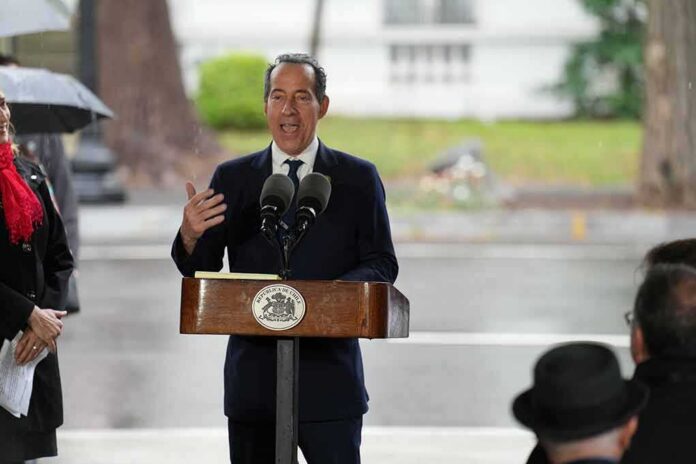
The real story here is not that a Democratic gathering included socialist voices; it is that a familiar American political dispute has been collapsed into a morality play, where attendance alone is treated as proof of ideological capture. The evidence supports a narrower, more defensible reading: Jamie Raskin appeared at a College Democrats convention that also featured socialist candidates and Hasan Piker, but the strongest source material shows his own remarks were about constitutional defense and anti-authoritarian politics, not an embrace of communism or socialism.
Key Points
- The convention did include socialist-aligned speakers and Hasan Piker, and one account says he appeared in Mao-like attire.
- The available primary material shows Raskin’s speech centered on the Constitution, separation of powers, and opposition to authoritarianism.
- A co-sponsor, J Street U, said it had no role in choosing speakers and disagreed with much of what Piker says.
- The claim that the event proves a Democratic “radical turn” is weaker than the claim that it reflects a noisy, broad progressive coalition.
What the Evidence Actually Shows About the Convention
The convention appears to have been a politically eclectic youth event rather than a clean ideological rally. The speaker list, as reported in the available coverage, included Raskin, David Hogg, Colorado socialist candidate Melat Kiros, Ohio candidate Kristina Knickerbocker, and Hasan Piker. That mix matters. It places a constitutional law-focused Democratic congressman on the same stage as candidates and activists located farther left on the party spectrum, but it does not, by itself, prove shared doctrine or institutional endorsement. In American politics, especially on campus, the boundaries between coalition-building, aspirational networking, and outright ideological alignment are often blurred on purpose.
The most sensational element is the clothing claim. One report described Piker as dressed like Mao Zedong, and the online reaction treated that as visual shorthand for communism. That reading is politically intelligible; Mao imagery is not subtle. But symbolism is not evidence of organizational alignment, and the record provided here does not include an on-the-spot statement from Raskin, a transcript showing endorsement, or any official program language that converts Piker’s costume into Democratic Party doctrine. The costume may be provocative, even deliberately so. It is still not proof of Raskin’s agreement with it.
Raskin’s Actual Message Was Constitutional, Not Revolutionary
The strongest counterweight to the radicalization framing is Raskin’s own public record and the speech summaries available here. In the College Democrats setting, he emphasized Article One, Article Two, and the 14th Amendment; he framed Trump and his allies as threats to democratic institutions, not as adversaries in an intraparty ideological struggle over socialism. That is consistent with Raskin’s broader public profile. Across other appearances, he has been documented defending constitutional limits, attacking election denialism, and arguing about rule-of-law questions in overtly institutional terms.
This matters because the original framing depends on an inference that is much stronger than the evidence permits: that physical proximity to socialist speakers implies sympathy with socialism. Raskin’s documented remarks point in the opposite direction. He speaks the language of constitutionalism, not class struggle. He does not present as a man sneaking communist ideas into mainstream Democratic politics; he presents as a lawyerly partisan who treats authoritarianism as the central danger of the age. That is a substantive difference, and it is the difference the more reliable material preserves.
The Institutional Question: Coalition-Building or Party Capture?
The fairest interpretation is that the convention reflected the Democratic coalition’s youth-facing breadth, not a unified ideological conversion. J Street U’s statement is important here because it directly undercuts the idea that every participant or co-sponsor owned the program’s speaker choices; it said it had “no role in choosing speakers,” no approval over the program, and no say in who was invited to address the conference, while also saying it disagreed with much of what Hasan Piker says. That is not what endorsement looks like. It is what distance looks like, and distance is the natural response when an organization is trying to share a stage without inheriting every speaker’s politics.
That same distinction helps explain why claims of a Democratic Party “socialist takeover” remain weak unless they are paired with harder evidence: platform changes, formal endorsements, policy adoption, or internal documents showing coordinated ideological intent. None of that appears in the supplied record. What appears instead is a recurrent pattern in which conservative outlets elevate the most provocative figures in a Democratic setting, then convert the visual shock into a general theory of party transformation. Sometimes that theory lands because the imagery is vivid. It is still a theory, not a demonstrated fact.
Why the Framing Keeps Returning
This episode fits a durable pattern in modern American media. When Democrats share a platform with figures to their left, critics often recast the event as proof that the party has crossed some ideological Rubicon. That is rhetorically effective because it simplifies complexity into a single moral signal: a congressman stood near a socialist, a socialist spoke to students, therefore the party is moving left in an existential way. But politics at the activist and campus level has long worked through proximity, not purity. Students hear from elected officials, movement intellectuals, local candidates, and celebrity advocates all in one room because those events are designed to generate energy, not doctrinal uniformity.
The relevant question is not whether the gathering contained voices many centrists would find objectionable. It did. The question is whether that fact establishes the broad claim being pushed onto it. On the record provided here, it does not. The convention demonstrates permeability on the Democratic left flank, a youthful appetite for sharper ideological language, and the continued usefulness of Hasan Piker as a cultural lightning rod. It does not demonstrate that Raskin, by attending, endorsed Maoism, communism, or even socialism. Presence is not confession. A shared stage is not a shared creed.
How to Read the Event Without Overreading It
The cleanest way to interpret the convention is to separate three things that partisan commentary often smashes together. First, there is the event itself, which included a mix of establishment Democrats, progressive activists, and explicit socialist candidates. Second, there is Piker’s performative style, which is designed to provoke and signal allegiance to a far-left aesthetic. Third, there is Raskin’s own political identity, which remains anchored in constitutional argument, anti-Trump litigation politics, and institutional defense. Those are related, but they are not identical.
That distinction also explains why the most sweeping version of the story remains underproved. If the claim is merely that a College Democrats convention can host figures farther left than many general-election Democrats would prefer, the evidence is ample. If the claim is that Jamie Raskin and “top Democrats” thereby joined or validated a communist or socialist project, the record is much thinner. The available sources support a story about coalition friction and symbolic provocation. They do not support a story about ideological surrender.
Sources:
thegatewaypundit.com, jpost.com, raskin.house.gov, amherststudent.com