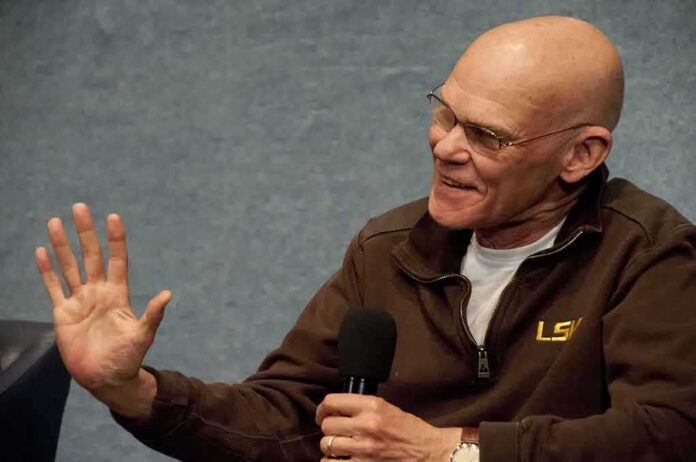
Democratic strategist James Carville told a Newsmax audience that President Trump’s administration is “more corrupt than all other administrations put together,” igniting a sharp, partisan shot at the White House.
Story Highlights
- Carville made his sweeping corruption claim on Newsmax, citing George H.W. Bush as a contrast.
- An advocacy group has published catalogs of alleged Trump-era misconduct, much of it uncharged.
- Media coverage focused on the superlative language rather than a defined standard of “corruption.”
- The claim lacks an agreed method to compare every administration across U.S. history.
Carville’s Charge On A Conservative Platform
James Carville used a Newsmax appearance to say the Trump administration is “more corrupt than all other administrations that came before it put together.” He contrasted this with President George H.W. Bush, whom he said was not corrupt. The remark landed because it was made to a conservative audience and delivered as a definitive judgment, not a question. Mediaite and Breitbart quickly highlighted the exchange, underscoring the direct, sweeping nature of his claim.
Carville’s phrasing carried a clear political edge. He framed the statement as a historical superlative, not limited to one scandal or officeholder. He did not lay out a scoring system, time frame, or metric that would let readers test the claim. That absence raised the stakes of the rhetoric while lowering its measurability. The clip still drove attention because it touched a raw nerve: who owns corruption in Washington now, and by what yardstick?
What The Public Records And Reports Actually Show
Outside the television moment, advocacy reports have tried to document ethics risks and alleged misconduct from Trump’s first term and campaign periods. Citizens for Responsibility and Ethics in Washington described thousands of potential conflicts between official duties and private business interests and called the first-term cabinet highly challenged on ethics. The same group cataloged dozens of alleged offenses tied to campaign finance, records handling, and disclosure issues. Many entries are allegations, not charges.
News coverage also noted that Trump was convicted in New York on felony counts for falsifying business records related to hush-money payments. That case provides adjudicated conduct rather than only allegations. But Carville’s claim went further than one case. His statement aimed to define an entire administration as surpassing all others, combined, on corruption. That kind of comparison needs a method to count and weigh convictions, conflicts, and abuses across every presidency, which was not supplied.
Why The Superlative Falls Short Of A Usable Measure
Carville’s wording turned a policy debate into a math problem with no numbers. Corruption can mean criminal convictions, ethics violations, conflicts of interest, or misuse of power. Those categories are not equal, and they are not tracked the same way across time. Without a shared system, any “most corrupt” label depends on which yardstick a speaker prefers. That is why the most powerful line in the clip also has the weakest footing as a historical test.
James Carville Tells Newsmax Viewers Trump Is 'More Corrupt Than All Other Administrations… Put Together' https://t.co/S7AMesuy1B
— Mediaite (@Mediaite) October 13, 2026
For readers who want clarity, a better approach would separate proven acts from allegations, list ethics findings agency by agency, and compare each administration using the same rules. That would include court records, inspector general reports, Office of Government Ethics files, campaign-finance actions, and documented conflicts. Until such a dataset exists, television one-liners will keep winning airtime while leaving people with more heat than light on a core issue: who is actually breaking public trust, and how do we know?
Sources:
mediaite.com, breitbart.com, citizensforethics.org, jurist.org