
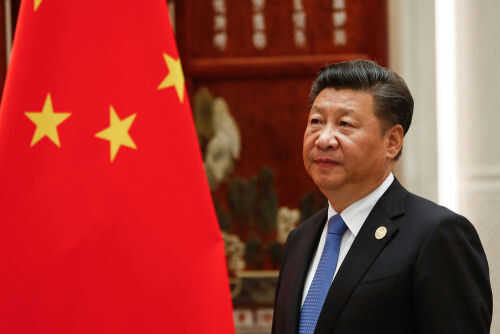
Xi Jinping’s warning about the “Thucydides trap” put the risk of a future United States-China clash in plain view during his meeting with Donald Trump.
Quick Take
- Xi publicly raised the “Thucydides trap” during talks with Trump, a phrase tied to war risk between a rising power and a ruling power.
- Xi has used the concept before, including at Davos, where he said the trap can be avoided through communication and sincerity [1].
- Video and summit coverage show Xi again urging a cooperative relationship and asking whether the two countries can build a new model of ties [2][3].
- The broader research on the concept warns that great-power rivalry, if mishandled, can slide into conflict, while diplomacy can still reduce the danger [6][7].
Xi Puts War Risk Back on the Table
Xi’s reference matters because it came in a setting where Washington and Beijing were already managing deep strategic mistrust, trade friction, and competing military interests. The “Thucydides trap” describes the pattern in which a rising power and an established power drift toward conflict when fear and miscalculation take over [6][7]. For readers who have watched globalist elites talk past hard realities for years, the warning underscores how dangerous weak leadership and fuzzy diplomacy can become.
South China Morning Post reporting says Xi had shown personal interest in the concept years earlier and had already used it publicly before the Trump era [1]. In Davos in 2017, Xi said the trap “can be avoided” if both sides maintain communication and treat each other with sincerity [1]. That line does not erase the danger; it confirms that the Chinese leader himself sees the risk as real. For conservative observers, that is a reminder that peace is preserved by strength and clarity, not wishful thinking.
What Xi Said During the Meeting
Video coverage of the bilateral talks shows Xi explicitly invoking the “Thucydides trap” and asking whether China and the United States can create “a new paradigm of relations” [2]. Other summit clips and summaries describe Xi striking a conciliatory tone and saying the two countries should be “partners, not rivals” [3][5]. That language suggests Beijing wants to project stability while still framing the rivalry as historic and potentially dangerous. It also shows why these meetings draw close attention from markets, allies, and military planners.
Harvard’s Graham Allison, whose work popularized the term, argues that the pattern behind the trap has repeatedly ended in war when a rising power challenges a ruling power [6]. His research says the modern United States-China relationship fits that dangerous framework, especially when trade conflict, naval competition, or an accident at sea can trigger escalation [6]. Even so, the same material leaves room for restraint. That matters, because common sense still says leaders can lower the temperature if they stop rewarding confrontation and start protecting American interests.
Why This Still Matters for Americans
The summit language should not be mistaken for a breakthrough on its own. Xi’s remarks were still tied to a framework that treats confrontation as a live possibility, and the research package repeatedly notes broader flashpoints such as trade, maritime tensions, and strategic mistrust [7][9]. For Americans who have already paid the price for years of economic mismanagement and foreign-policy drift, the takeaway is simple: the country cannot afford another era of weakness dressed up as “engagement.”
Xi referred to the Thucydides Trap at the start of his bilateral talks with Trump:
The question now, Xi said, is “whether China and the United States can transcend the so-called Thucydides Trap and pioneer a new paradigm of major-country relations,” referring to a term that…
— Katherine Doyle (@katiadoyl) May 14, 2026
At the same time, Xi’s own words also show that war is not automatic. He tied the risk to communication, sincerity, and a willingness to avoid miscalculation [1][2]. That does not make the Chinese Communist Party trustworthy, and it does not mean American leaders should ignore hard realities in the Pacific. It does mean the administration in Washington must stay focused on deterrence, industrial strength, and the defense of U.S. sovereignty rather than empty slogans about global harmony.
Sources:
[1] Web – Destined for conflict? Xi Jinping, Donald Trump and the Thucydides …
[2] YouTube – Xi Jinping Tells Trump China and US Must Be ‘Partners, Not Rivals …
[3] YouTube – Beijing Summit | Xi Tells Trump: “We Should Be Partners, Not Rivals”
[5] YouTube – Trump Tells Xi: “We’ve Had A Fantastic Relationship” | Beijing Summit
[6] Web – Destined for War: Can America and China Escape Thucydides’s Trap?
[7] Web – Can the US and China Avoid the Thucydides Trap? – JSTOR Daily
[9] Web – Xi Jinping to Donald Trump in Beijing: ‘Partners, Not Rivals’ …