
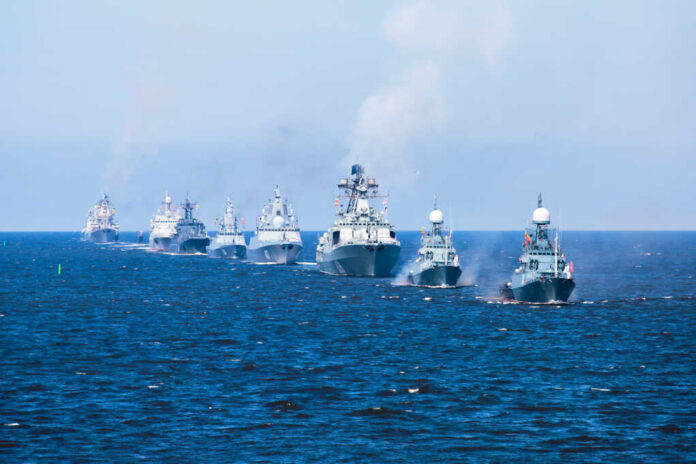
Britain quietly forges a “family of allied fleets” to box in Russia’s Northern Fleet, raising the stakes in a shadowy underwater arms race that could reshape Arctic power balances overnight.[2][3]
Story Snapshot
- UK Royal Navy Chief Sir Gwyn Jenkins unveils Northern Navies Initiative on April 29, 2026, targeting Russian sub-sea threats in the High North.[2]
- Ten Joint Expeditionary Force nations sign statement of intent for integrated fleets, sharing platforms, logistics, and command under UK leadership.[1]
- Hybrid navy with drones, AI, and uncrewed systems aims for full readiness by 2029, complementing NATO via programs like Atlantic Bastion.[3]
- Excludes US, Germany, France, sparking debates on European autonomy amid Russian countermeasures and alliance fractures.[3]
- Builds on UK-Norway Lunna House accord to deter along GIUK gap and Baltic routes.[2]
Announcement Ignites Northern Naval Coalition
Sir Gwyn Jenkins, UK Royal Navy First Sea Lord, announced the Northern Navies Initiative during his April 29 speech at the Royal United Services Institute in London. He hosted northern European naval chiefs on April 23, securing a signed statement of intent. The group commits to detailed proposals for a multinational force defending northwest Europe and the High North against Russia.[2]
Jenkins emphasized creating a “family of allied fleets” trained under Royal Navy standards. The force operates from Northwood’s Maritime Operations Centre, using UK doctrine for integration. Nations interchange equipment, personnel, ammunition, and digital networks to build collective strength greater than individual parts.[1][2]
Countering Russia’s Underwater Edge
Russia bolsters its Northern Fleet, testing NATO in the underwater domain through enhanced sub-sea capabilities. The initiative responds with Atlantic Bastion, a layered sensor network of drones, underwater vehicles, and surveillance systems. This detects hostile activity and relays data for rapid offensive strikes.[3][2]
Specific assets integrate seamlessly: UK Type 45 destroyers, Type 23, 26, and 31 frigates plus submarines; Norway’s Fridtjof Nansen frigates; Denmark’s Iver Huitfeldt frigates and Absalon ships; Sweden’s Visby corvettes and Gotland submarines; Finland’s Pohjanmaa corvettes. Unified logistics and joint training target 2029 readiness.[1]
The hybrid fleet paradigm shifts incorporate uncrewed systems, drones, and AI platforms. Jenkins described this as increasing mass, survivability, and lethality. Royal Fleet Auxiliary ships like Lyme Bay convert into motherships for autonomous mine hunting, drawing auxiliaries into combat roles.[3]
Roots in Joint Expeditionary Force Framework
The Northern Navies builds on the UK-led Joint Expeditionary Force, comprising UK, Norway, Denmark, Sweden, Finland, Iceland, Netherlands, Estonia, Latvia, and Lithuania. Canada eyes participation. This minilateral group spans Nordic and Baltic regions along Russia’s “open sea border.”[3][1]
It complements NATO, not competes, per Jenkins. Like JEF’s rapid response model, it seizes initiatives in vital areas without draining alliance resources. The bilateral UK-Norway Lunna House accord from late 2025 deepens ties, combining navies against Russian North Atlantic activity.[2]
Thread 🧵2/5
As the First Sea Lord confirmed, this Northern Navies initiative is designed to deter Russian maritime threats across the High North, North Atlantic, and Baltic. It will combine conventional assets with unmanned and autonomous systems.#NationalSecurity… pic.twitter.com/7iQZ1a0EVn
— The British Defence & Alliance For Action (@BDAA_Official) May 9, 2026
Conservatives applaud this self-reliant European deterrence, aligning with common sense burden-sharing. Facts show smaller navies pooling high-end capabilities deter aggression effectively, proving collective action trumps solo efforts against Russia’s provocations.[2][3]
Challenges and Escalation Risks
Weaknesses persist: no binding funding or procurement details beyond intent. Exclusion of US, Germany, France, and Poland leaves gaps in Baltic coverage. Success metrics for deterrence remain undefined without Russian activity baselines.[1][3]
Russia views it as encirclement, with Deputy Foreign Minister Alexander Grushko labeling related exercises an “act of war” over Kaliningrad simulations. Escorts protect shadow fleet vessels in the Gulf of Finland, signaling countermeasures. Alternative routes like the North-South Corridor blunt chokepoint leverage.
Amid Trump-era NATO strains, this UK-helmed bloc hints at European independence. Yet Russian threats of escalation in patrols risk trade disruptions. Common sense demands verified commitments and data to validate deterrence without miscalculation.[3][1]
Sources:
[1] Web – The UK’s New Multinational Naval Initiative Aims To Contain Russia …
[2] Web – UK Royal Navy Chief Announces Northern Navies Plan to Enhance …
[3] Web – UK to lead European “Northern Navies” force against Russia