
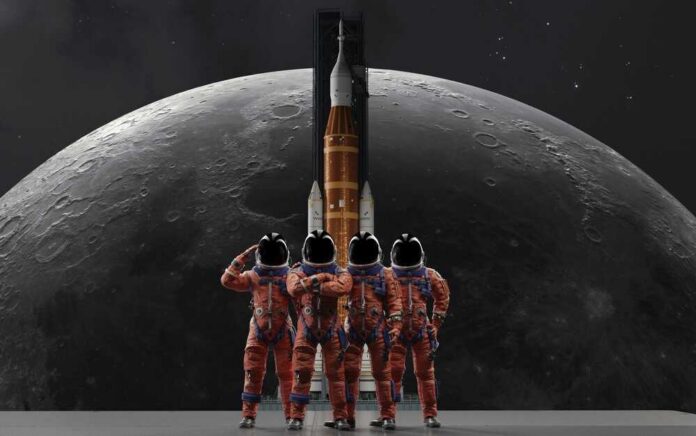
America’s astronauts just shattered a 56-year space record, soaring farther from Earth than any humans before—proof that bold American leadership still conquers the stars.
Story Highlights
- Artemis II crew completed historic lunar flyby on April 6, 2026, passing 4,067 miles above the Moon’s surface.
- Broke Apollo 13’s distance record at 252,756 miles from Earth, first crewed lunar mission since 1972.
- Captured live images of lunar far side, observed Earthrise, Earthset, solar eclipse, and meteoroid impacts.
- President Donald J. Trump congratulated the crew live, affirming U.S. space dominance.
- Mission validates Orion spacecraft for future lunar landings and Mars exploration.
Crew Achieves Lunar Flyby Milestones
NASA astronauts Reid Wiseman, Victor Glover, and Christina Koch, alongside Canadian Space Agency astronaut Jeremy Hansen, executed a precise seven-hour lunar flyby on April 6, 2026. At 1:56 p.m. EDT, they surpassed Apollo 13’s record of 248,655 miles from Earth. Lunar observations began at 2:45 p.m. EDT, with closest approach at 7:00 p.m. EDT, just 4,067 miles above the surface while traveling 3,139 mph relative to the Moon. This marked the first crewed venture near the Moon since Apollo 17 in 1972, restoring American pioneering spirit in space.
Record-Breaking Distance and Scientific Firsts
Between 7:02 and 7:05 p.m. EDT, the crew reached a maximum distance of 252,756 miles from Earth, exceeding Apollo 13 by 4,111 miles. They photographed craters, lava flows, and ridges on the lunar far side, providing fresh data on surface composition through color and texture analysis. The team witnessed Earthset and Earthrise from Orion, analyzed the solar corona during a one-hour eclipse, and reported six meteoroid flashes—achievements impossible in prior missions. These observations advance lunar science while testing deep-space systems essential for national security and exploration.
During the flyby, a planned 40-minute signal loss occurred around 6:41 p.m. EDT as Orion passed behind the Moon. Observations ended at 9:35 p.m. EDT, transitioning to the return trajectory. Orion will exit the lunar sphere of influence on April 7 at approximately 1:25 p.m. EDT, 41,072 miles from the Moon. This free-return path at 60,863 mph relative to Earth ensures safe homeward progress without orbit insertion.
Presidential Recognition and Broader Impacts
President Donald J. Trump spoke live with the crew post-flyby, congratulating their success and highlighting U.S. leadership. This interaction underscores how federal investment in space yields tangible victories, countering elite skepticism about ambitious programs. Short-term, the mission validates Orion’s life support and propulsion for Artemis III landings targeted for 2027. Long-term, it paves the way for Mars missions, bolstering economic growth through commercial lunar opportunities and inspiring STEM pursuits among youth frustrated by government overreach elsewhere.
NASA scientists praised the crew’s real-time reports for revealing lunar evolutionary clues. The international partnership with Canada via the Artemis Accords strengthens alliances without ceding American primacy. Public excitement renews faith in human ingenuity, reminding citizens on both sides of the aisle that competent execution transcends partisan gridlock and elite failures in Washington.
Sources:
Artemis II Flight Day 6: Crew Wraps Historic Lunar Flyby
Artemis II Flight Day 6: Lunar Flyby Updates