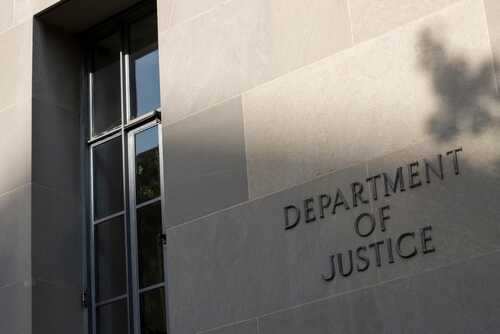
After years of watching taxpayer money evaporate through “guardrail-free” federal programs, the Trump Justice Department is building a new fraud-hunting command post that could either recover billions—or ignite a fierce fight over who controls federal prosecutions.
Story Snapshot
- President Trump nominated federal prosecutor Colin McDonald to serve as the first Assistant Attorney General for National Fraud Enforcement, a newly created DOJ leadership post.
- The new National Fraud Enforcement Division was announced earlier this month by Vice President JD Vance and is designed to coordinate fraud investigations across federal programs nationwide.
- Federal enforcement attention has centered on alleged large-scale schemes in Democratic-run states including Minnesota and California, where investigations are already underway.
- Legal analysts say the division’s proposed reporting structure is unusual, with competing descriptions about whether the new AAG answers to the White House or inside DOJ leadership.
Trump’s Nominee: A New DOJ Post Built Around Fraud Cases
President Donald Trump announced on January 28, 2026, that he is nominating Colin McDonald to become the first Assistant Attorney General for National Fraud Enforcement. McDonald currently serves as an Associate Deputy Attorney General, and Deputy Attorney General Todd Blanche has publicly praised him for handling high-stakes matters. The nomination now moves toward Senate confirmation, which will determine how quickly the new division gains full authority and staffing.
Vice President JD Vance previewed the plan earlier, on January 8, during a White House briefing that introduced the National Fraud Enforcement Division as a centralized effort to investigate and prosecute fraud tied to federal programs. The public-facing message from Trump and Vance has emphasized recovering taxpayer dollars and stopping sophisticated scams that exploit federal spending streams. The administration has framed the project as a “restore integrity” initiative, not a routine reshuffle of existing DOJ units.
President Trump has nominated COLIN MCDONALD to serve as the First ever AAG For the National Fraud Enforcement division.
McDonald is a lead lawyer who has quite a bit of trial experience, and often works with the FBI, DEA, and ATF. He worked on the Kealoha Public Corruption Case… pic.twitter.com/JAYfWkz3uH
— America First Insight (@AF_Insight) January 28, 2026
Why Minnesota and California Keep Showing Up in This Story
The new division is launching against a backdrop of ongoing federal investigations into major fraud schemes in Minnesota and California, according to the administration’s fact sheet and related reporting. Federal agencies have already surged resources: DOJ has increased attorney capacity in Minnesota, the FBI has deployed forensic support, and the Department of Homeland Security has taken a visible role in field checks connected to program integrity. The stated goal is coordinated enforcement across districts rather than isolated prosecutions.
Congress is also engaged. The House Oversight Committee has widened its probe into Minnesota fraud allegations, adding political momentum and pressure for clearer answers on how such schemes were allowed to grow. Separately, public attention has been fueled by viral reporting that highlighted vulnerable reimbursement systems and alleged weak oversight at the state level. Federal authorities have already brought charges in at least one Minnesota-linked facility case, showing the enforcement pipeline is active even before the new division is fully built out.
The Structural Controversy: Who Oversees This “Fraud Czar”?
The sharpest policy question is not whether fraud should be prosecuted—it’s how this new enforcement structure will be supervised. Legal analysts have flagged the division as a notable departure from typical DOJ architecture because early descriptions suggested a direct White House supervision component. Vance publicly characterized the role as having “all the benefits of special counsel,” language that implies unusual authority and a unique mandate compared with existing fraud sections inside DOJ.
A separate analysis highlighted a key contradiction: public statements indicated White House supervision, while a DOJ organizational depiction suggested reporting through the Deputy Attorney General. That difference matters because DOJ independence has long been treated as a stabilizing norm, especially in politically charged seasons. With the 2026 midterms approaching and with investigations focusing on Democratic-controlled states, the administration will likely face sustained scrutiny on guardrails, transparency, and the limits of executive influence.
What This Means for Taxpayers—and for the Constitution’s Checks and Balances
From a limited-government perspective, the most compelling argument for the new division is also the simplest: if federal programs are being looted, the public deserves an aggressive, coordinated response that stops the losses and prosecutes offenders. The White House framing centers on accountability for “fraudsters stealing from the American people,” and the operational details—multi-agency deployments, added prosecutors, and national coordination—signal an intent to move quickly rather than let cases languish.
At the same time, the administration will have to prove that speed and focus do not come at the expense of due process or clean lines of authority. The available research points to unresolved questions about supervision, scope, and staffing that will be tested during confirmation and implementation. If the division is structured with clear oversight inside the DOJ, the effort could strengthen public confidence in how federal dollars are protected; if not, critics will keep arguing it blurs separation-of-powers norms.
Sources:
Trump taps Colin McDonald for newly created role of Assistant Attorney General for Fraud Enforcement
Trump Administration Rolls Out New DOJ Division for National Fraud Enforcement
The Division for National Fraud Enforcement: What We Know So Far
Trump Nominates US Prosecutor as Top National Fraud Investigator