
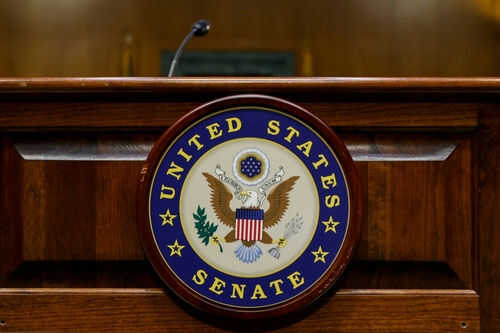
Senate Democrats are blocking Homeland Security funding unless Congress rewrites immigration enforcement—turning basic government operations into leverage during a partial shutdown.
Quick Take
- The House previously passed the FY2026 DHS appropriations bill, but the Senate has repeatedly stalled it, pushing DHS deeper into shutdown conditions.
- Democratic demands center on ICE “guardrails,” including limits on enforcement locations and added warrant requirements, rather than a clean funding vote.
- Republicans are pursuing a short-term continuing resolution, but Senate leaders have signaled resistance without policy concessions.
- Operational impacts are spreading, including federal worker pay disruptions and increasing strain on TSA, while FEMA relies on reserves for limited continuity.
What the DHS funding fight is really about
House Republicans advanced H.R. 7147, the Department of Homeland Security Appropriations Act, 2026, and the House passed it in late January as part of a broader spending package. Senate Democrats, however, pushed to separate DHS from the rest of the package and demanded immigration-related changes tied to ICE operations. The result is a legislative stalemate where the policy dispute is eclipsing the basic need to fund core security agencies.
Several headlines and social posts have floated an “Iran war” connection to the funding push, but the underlying documentation in the available research does not substantiate that linkage. The confirmed dispute is appropriations process and immigration enforcement policy riders. Readers should separate what is verifiable—House passage, Senate procedural blocks, and immigration conditions—from what remains unverified in the cited coverage summaries.
House passage vs. Senate blockade: how the shutdown pressure built
The House vote set the stage: the DHS bill cleared the chamber 220–207 after the Rules Committee reported it on a party-line-style margin, reflecting how tight the numbers are. After that, the Senate route ran into the 60-vote cloture reality, where Democrats can block advancement. Reports describe the Senate effort stalling as Democrats sought leverage to force a different structure and policy outcomes than the House-approved approach.
As the continuing resolution deadline passed, the shutdown consequences shifted from theoretical to real. Senate votes to advance the House-backed approach failed, and later reporting described a second failed vote as the partial shutdown extended beyond a week. Republican leadership discussed a short continuing resolution—often described as four to six weeks—aimed at reopening operations while negotiations continued, but Democratic leaders rejected that path absent enforcement changes.
What Democrats are demanding on ICE, and why it matters
The specific “guardrails” discussed in the research focus on ICE conduct and enforcement limits, including restrictions involving sensitive locations and added warrant requirements. House Democrats also filed a wave of amendments aimed at reshaping enforcement practices, including measures related to identification, masking, detention processes, and oversight mechanisms. Supporters frame those provisions as accountability reforms; critics see them as using funding deadlines to weaken immigration enforcement through procedural constraints.
For conservatives focused on constitutional governance, the core issue is not whether agencies should follow the law—of course they should—but whether Congress should routinely condition baseline funding for essential departments on major policy rewrites that cannot pass on their own merits. When DHS funding becomes a bargaining chip, lawmakers effectively risk national security functions, border enforcement capacity, and public-facing services to force political outcomes through brinkmanship rather than regular order.
Operational fallout: TSA delays, FEMA reserves, and enforcement disruptions
Shutdown conditions do not hit all DHS components evenly, but the research highlights several pressure points. TSA disruptions can build as pay delays ripple into staffing and travel throughput, especially during high-volume seasons. FEMA is described as operating with reserves for a limited time window, while other components draw on remaining funds or prior-year resources. The longer the impasse lasts, the more these temporary patches become operational risks rather than accounting maneuvers.
House to vote again on DHS funding as GOP stresses urgency amid Iran warhttps://t.co/src5PbikgA
— christine (@cmonkman1) March 5, 2026
Immigration enforcement is also affected. The research indicates that a lapse can halt or constrain ICE activity, even as the policy debate centers on limiting enforcement further through new conditions. That leaves the country with the worst of both worlds: agencies are starved for predictable funding while lawmakers argue about writing new restrictions into must-pass legislation. The research does not provide a confirmed resolution timeline, underscoring how unstable the endgame remains.
Sources:
Senate Vote on House-Passed Spending Package Stalled as Senate Democrats Seek Separate Vote on DHS
PIH-FY2026-Homeland Appropriations
Senate vote DHS shutdown ICE reforms