
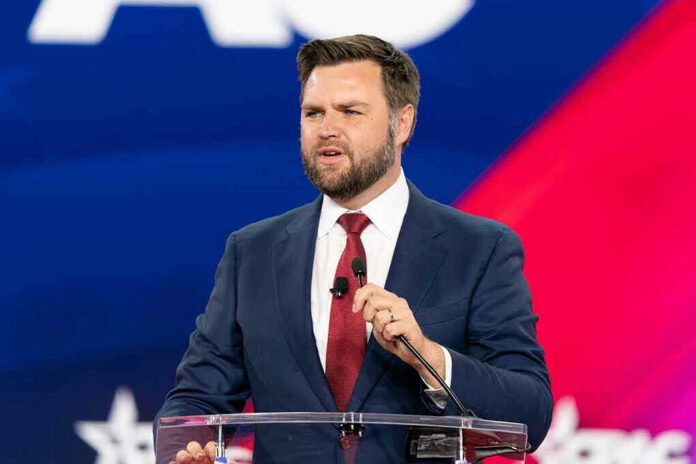
President Trump ordered Vice President JD Vance to pivot from Iran talks to targeting alleged corruption in Democrat-run cities and states.
Story Highlights
- Trump said the United States does not need an Iran deal and redirected Vance to domestic corruption work.
- Trump cited U.S. leverage over Iran’s money and shipping as reasons to avoid a deal.
- Trump claimed rooting out large-scale fraud could help balance the budget.
- Vance had recently said talks with Iran showed progress before the shift.
Trump Redirects Vance From Iran To Domestic Corruption Push
On November 12, 2026, President Trump said the United States does not need an agreement with Iran and instructed Vice President JD Vance to shift his focus to alleged corruption in Democrat-led cities and states. Trump made the change public and said the new push aims at crime, waste, and fraud he argues are draining public resources. Reports confirmed the directive and described it as a clear end to Vance’s role in Iran talks at this time.
Trump argued that the United States holds enough leverage to skip a deal. He pointed to control over Iran-linked funds and maritime pressure near vital shipping lanes. He framed the strategy as keeping pressure on Tehran, including support for a continued naval posture and economic measures. Outlets reported that the White House is favoring pressure over concessions, with no new negotiating track announced to replace Vance’s former role.
Fiscal Rationale: Target Fraud To Protect Taxpayers
Trump tied the shift to a budget goal, saying widespread fraud in blue jurisdictions costs taxpayers heavily. He argued that cracking down could help balance the budget more quickly. He did not publish a program score or dollar estimate beyond general claims, but he cast the mission in simple terms: stop waste, recover funds, and end policies that reward mismanagement. Coverage repeated his claim that cleaning up corruption could change the nation’s fiscal path.
Conservatives see this as a law-and-order turn after years of soft-on-crime policies. The plan speaks to readers who want safe streets, honest books, and real consequences. It also aligns with priorities like limited government and local accountability. Trump’s message targets cities and states where high taxes, rising costs, and broken services have pushed families out. The promise is clear: stop abuses, return power to citizens, and defend the rule of law.
Policy Whiplash: Vance Had Reported Progress In Talks
Days before the order, Vance said the United States had “good conversations” with Iran and that a settlement needed firm, verifiable nuclear limits. He also said there had been progress toward a deal. Those comments set a tone for continued diplomacy, which makes the shift notable. The reporting does not explain what new information, if any, drove the decision to pull Vance from the file and end that diplomatic push.
The change also follows a season of debate about the Iran war and its political effects. Vance had urged a path to end the fighting and reduce costs, while Trump stressed that preventing a nuclear weapon is nonnegotiable. The new approach keeps pressure on Iran without trading leverage for relief. For many on the right, this meets a core demand: do not reward a hostile regime, do not fuel terror proxies, and keep America strong at sea and in markets.
What Comes Next For Blue-State Governance
The redirection raises practical questions about scope and tools. The Justice Department, inspectors general, and state attorneys general hold formal investigative powers. The White House has not released a public charter describing how Vance will coordinate efforts, select cases, or measure results. The administration’s message is nonetheless direct: federal partners should prioritize fraud, contracts, and grant misuse where taxpayers lose most, especially in jurisdictions with chronic failures.
Trump Pulls Vance From Iran Negotiations, Orders Him To Focus On Blue State Corruption
President Donald Trump pulled Vice President JD Vance from negotiating with Iran, asking him to focus on blue-state corruption instead.
Trump declared, "We don't need a deal with Iran," in a…
— Parallel Polis in Exile 🇺🇸 (@Polis_in_Exile) November 13, 2026
For families facing high prices, high taxes, and rising crime, the signal is welcome. A focused anti-corruption drive can defend pensions, schools, and public safety by stopping waste and graft. A firm Iran posture can reduce global risk and protect energy flows without new giveaways. The test now is execution. Clear targets, fast wins, and honest reporting will show whether this shift delivers real relief at home while keeping pressure abroad where it counts.
Sources:
cleveland.com, newsobserver.com, axios.com, telegraph.co.uk