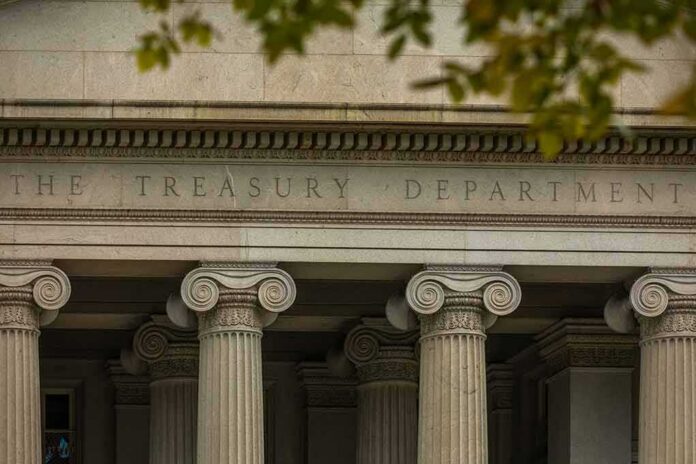
Treasury Secretary Scott Bessent told Congress there are ways to deliver President Trump’s $5,000 dividend without adding to the debt or deficit, sharpening a high-stakes fight over costs and inflation.
Story Highlights
- Treasury Secretary Scott Bessent said the dividend can be funded without new borrowing.
- Critics claim the plan could cost about $1.2 trillion and stoke inflation.
- President Trump and Vice President JD Vance point to tariff revenue as the funding source.
- Skeptical lawmakers and outlets warn tariff receipts may fall short of the total cost.
What Bessent Told Lawmakers About Funding Without More Debt
Treasury Secretary Scott Bessent testified that the administration is “working on it” and sees ways to send Americans $5,000 checks without increasing federal debt or the deficit. His remarks came as the national debt sits near $40 trillion, keeping fiscal discipline in the spotlight. Bessent’s comments align with the administration’s push to fund the payout from trade duties rather than new borrowing. Bloomberg also reported Bessent believes the program can be structured to avoid deficit impact.
President Trump and Vice President JD Vance have repeatedly tied the dividend to tariff revenue. They argue that receipts from broader and higher duties on imports can cover the checks. This frames the dividend as returning trade proceeds to citizens instead of growing government. Yale’s Budget Lab analysis, cited by press accounts, says tariff-linked rebates can exist with modest price effects if designed as true rebates tied to collections — an approach consistent with what the White House signals.
Why Critics Warn of A $1.2 Trillion Hole and Higher Prices
The Committee for a Responsible Federal Budget, a deficit watchdog, estimates the plan would cost about $1.2 trillion if every adult receives $5,000. The group says that price tag would widen the deficit, raise borrowing costs, and likely fuel inflation in the near term. Several outlets echo similar inflation fears, drawing parallels to the pandemic-era checks that boosted spending when supply was tight. These concerns remain central to pushback from budget hawks.
Reporters and analysts also question whether tariff revenue alone can cover the full payout. CBS News reported that duties would likely fall short, forcing the government to issue debt unless offsets are found. That aligns with skeptical voices in Congress who ask for a detailed score and legal vehicle before moving ahead. Supporters reply that a properly sequenced rollout, paired with discipline on offsets, can keep the plan neutral to the deficit.
The Stakes for Families, Prices, and Fiscal Restraint
Working families face real cost pressure from groceries, gas, and housing. A $5,000 check could offer short-term relief. The question is timing and funding. If the money comes from tariff receipts and matched offsets, inflation risk could ease. If it relies on borrowing, critics fear a repeat of price spikes and rate hikes. The White House says it aims for the first path. Watchdogs insist on a bill, a score, and clear pay-fors before any checks go out.
Trump says the $5,000 dividend "will happen", as elected Republicans line up publicly against it.
He gave no new detail on timing or funding, arguing Americans deserve to benefit from what he described as trillions of dollars of economic development and investment: "When I say…
— Tiberiade (@tiberiadex) September 12, 2026
Conservatives want Washington to stop the debt spiral, cut waste, and defend American industry. A tariff-funded dividend can fit that if it truly uses trade revenue, not new IOUs. The administration now carries the burden to show the math, sequence payments with collections, and lock in safeguards against deficit creep. Until Congress sees the legislative text and official estimates, the debate will stay hot, and the outcome will turn on proof, not promises.
Sources:
youtube.com, investing.com, politifact.com, fool.com, cnbc.com