
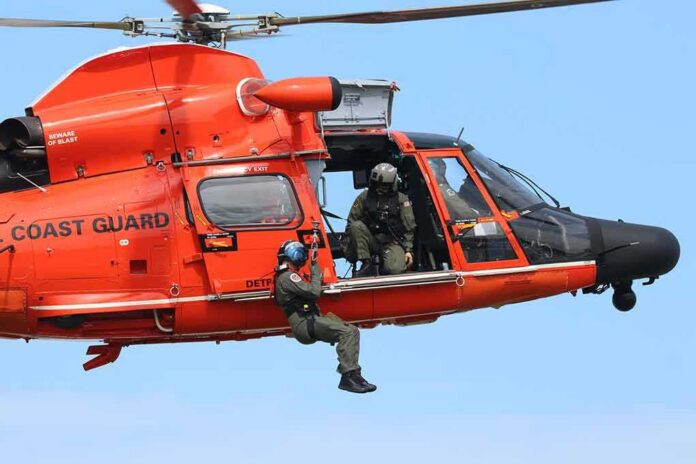
Six Americans—four adults and two children—are missing after a single-engine plane went down off Mississippi’s coast, prompting a full federal search-and-rescue push.
Story Snapshot
- The U.S. Coast Guard says six people were aboard the downed Cessna near Horn Island.
- Debris, life jackets, a life raft, and the aircraft cabin were found two miles northeast of Horn Island.
- The flight left New Orleans Lakefront Airport bound for Fort Myers, Florida, officials said.
- Federal and state agencies are searching; the National Transportation Safety Board is investigating.
What Officials Confirm About The Flight And Crash Area
U.S. Coast Guard Sector Mobile reported that a small Cessna with four adults and two children crashed northeast of Horn Island on Tuesday afternoon. Multiple outlets, citing the Coast Guard, placed the debris about two nautical miles off the island. Responders located part of the aircraft cabin, three life jackets, and a life raft in the water, confirming a hard hit and breakup in the surf zone. Crews marked the debris field and continued grid searches as daylight faded and tides shifted.
Local reporting tied the flight plan to a straightforward Gulf-hop. Officials said the aircraft departed New Orleans Lakefront Airport and was headed to Page Field Airport in Fort Myers, Florida. Timelines varied slightly across reports, with one placing the emergency near 3 p.m. and another noting the Federal Aviation Administration lost contact around 3:45 p.m. That gap often reflects the difference between last contact and first distress calls in fast-moving aviation events.
The Multi-Agency Search And Who Is Leading The Probe
Search and rescue teams included the U.S. Coast Guard, the Mississippi Department of Marine Resources, and local partners scanning sea lanes and shoals near the barrier islands. The Federal Aviation Administration and the National Transportation Safety Board (NTSB) were notified, with the NTSB taking charge of the safety investigation, as is standard in civil aviation accidents. Investigators will gather radar, radio traffic, maintenance history, and wreckage evidence to map the sequence and assess any mechanical or human factors.
The National Transportation Safety Board typically issues a preliminary report within weeks, which provides early facts but not cause. Federal Aviation Administration guidance explains that investigators secure the site, catalog parts, and coordinate with first responders while data is compiled and verified before public release. Families often want answers on day one, but aviation investigations move step by step so findings hold up in courtrooms and training classrooms alike.
Why Rescue Efforts Continue And What Survival Data Suggests
Coast Guard swimmers and boat crews kept searching because debris alone does not decide an outcome. A peer‑reviewed study of aircraft ditchings from 1989 to 2022 found that, when search details were available, more than one‑third of occupants were rescued by the Coast Guard, and others survived with help from nearby boats or by reaching shore. Warm Gulf waters, flotation gear, and quick grid patterns can buy precious time. That is why commanders press the hunt even as daylight and weather challenge crews.
Officials have not released names or ages, and outlets differ on the exact model beyond calling it a Cessna, with some citing a Cessna 210 Centurion. Those details will settle as records, parts, and serial numbers are matched. For now, the headline facts are firm: six souls on board, debris and survival gear recovered, and a concentrated search northeast of Horn Island. That is the mission picture, and it is drawing full federal attention until every lead is run down.
Sources:
ksl.com, cnn.com, aircrashdb.com, nola.com, edition.cnn.com, wlox.com