
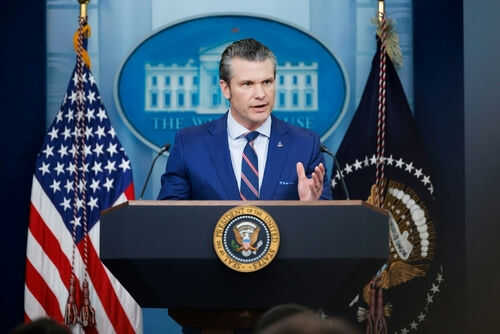
A major new Pentagon review could finally end decades of European “free‑riding” on the backs of American taxpayers and troops.
Story Snapshot
- Pete Hegseth launched a six‑month “NATO 3.0” review of U.S. troops and bases in Europe.
- Future U.S. NATO payments and deployments are now tied to allies meeting defense‑spending promises.
- Hegseth blasted European governments for blocking bases and airspace during the Iran war.
- The review aims to shift Europe to primary responsibility for its own defense while freeing U.S. forces for global needs.
Hegseth Draws a Line: No More One‑Way NATO
U.S. Defense Secretary Pete Hegseth told NATO defense ministers in Brussels that the Pentagon is starting a formal six‑month review of America’s force posture and basing in Europe, a process he stressed will be “a real review” with real consequences.[4] He said the goal is simple but long overdue: push Europe to take primary responsibility for defending its own continent so American forces are not stuck carrying the load while facing threats from Iran, China, and beyond.[2]
Hegseth described years of NATO drift as turning the alliance into a “paper tiger” and “one‑way street,” with the United States writing the checks, providing the planes, and taking the risks while too many European governments underfund their militaries.[1] He warned that U.S. “NATO dues” and some crisis‑response support would now be tied to whether allies actually meet their spending targets instead of hiding behind nice speeches and empty communiqués.[3]
Review Targets Basing, Spending, and Access to Protect U.S. Interests
The NATO 3.0 review will dig into where U.S. troops are based in Europe, how they are used, and whether those locations still serve American global priorities.[4] Hegseth said the review will involve U.S. European Command, Congress, and allies, but he made clear that Washington’s first duty is to American security and American families, not to maintaining the status quo for European comfort.[4] The administration has already signaled reductions in some aircraft, drones, and ships earmarked for NATO crisis use.[4]
Recent reporting says cutbacks include a one‑third drop in F‑15 and F‑15E fighter jets assigned to NATO missions and a 50 percent reduction in Reaper drones, showing that the United States is already trimming support assets that Europeans long took for granted.[4] Hegseth’s team also wants written guarantees on access, basing, and overflight, so American forces are never again blocked mid‑crisis by governments that depend on U.S. protection when it suits them.[4]
Iran War Access Fight Exposes Cost of European “Free‑Riding”
Hegseth blasted several allies for what he called “shameful” behavior during the war with Iran, when some governments restricted or denied U.S. access to bases and airspace for potential operations.[1] He warned that these decisions put “America’s sons and daughters” at greater risk by forcing longer routes and more dangerous missions, even as those same countries still relied on the American security umbrella.[1] For many conservatives, this episode confirms that Europe wants U.S. protection without real sacrifice.
The new review sends a blunt message: if European leaders will not back America in real conflicts, Washington will not automatically keep underwriting their defense. Hegseth said NATO 3.0 must become a “real hard‑line military alliance” with real capabilities, not a talking shop that expects the Pentagon to fix every crisis.[5] That means more European spending, more local forces on the ground, and reliable political support when American troops are in harm’s way, not lectures about “globalism” while U.S. pilots fly the missions.[5]
What This Shift Means for American Taxpayers and Troops
Policy experts note that the United States maintains a large network of bases in Europe that support not only NATO but also operations in the Middle East, Africa, and beyond.[15] Generals have warned that once those facilities are closed, they are hard and costly to rebuild, which is why past reviews often turned into half‑measures.[15] Hegseth’s six‑month timeline, coupled with active cutbacks in aircraft and drones, suggests this review is more than a bluff designed to get headlines.[4]
NEW: The sweeping review of the U.S military presence in Europe will be led by Gen. Alexus Grynkewich, the head of U.S. European Command, and the assessment has no predetermined outcome, a U.S. official told Air & Space Forces Magazine. Grynkewich also serves as Supreme Allied…
— Chris Gordon (@ByChrisGordon) June 18, 2026
For conservatives at home, the stakes are clear: every dollar and brigade tied down in Europe is a dollar and unit not ready for threats at the southern border, in the Pacific, or against terrorism. Analysts have long argued that any reductions in Europe should follow a serious strategic review and real consultations, not political tantrums.[16] By putting this debate on a formal footing and tying it to hard metrics like spending and access, the Trump administration is finally forcing Europe to choose between comfort and responsibility.
Sources:
[1] Web – Hegseth Announces Review of US Forces in Europe
[2] Web – Hegseth blasts NATO members, announces review of US forces in …
[3] Web – Pentagon chief announces NATO 3.0 review of US force posture in …
[4] Web – Hegseth lashes out at NATO allies and announces a review of U.S. …
[5] Web – Remarks by Secretary of War Pete Hegseth at the 2026 NATO …
[15] Web – Strengthening NATO’s eastern flank | NATO Topic
[16] Web – Pentagon chief lashes out at NATO allies and announces a review …